
Curry Barker’s Obsession starts with a premise simple enough to sound familiar, then uses that familiarity to sneak audiences somewhere much more unsettling. Released by Focus Features on May 15, 2026, the film follows Bear, a shy music store employee who makes a wish using a supernatural object called the “One Wish Willow,” only to find that getting exactly what he wanted comes with a sinister cost. Michael Johnston and Inde Navarrette lead the film, with Cooper Tomlinson, Megan Lawless, and Andy Richter in supporting roles.
What makes Obsession work so well is not just the hook, but the control behind it. This is a horror film that understands how to move with intention, knowing when to soften its touch, when to tighten the screws, and when to let discomfort build through implication rather than sheer force. By the end, the result is a sinister, smart, and sharply tuned film that never loses sight of the emotional damage at the center of its story.
Focus Features
Michael Johnston and Inde Navarrette make every turn matter
The strongest thing in the film may be its two leads. Johnston and Navarrette do not simply sell the escalating horror. They make the shifting emotional reality of the film feel entirely believable at every stage.
Johnston plays Bear with a careful, almost naive softness that becomes one of the film’s most dangerous qualities. There is an easy charm to him, something gentle and unthreatening on the surface, which makes the character’s choices even more unsettling as the story goes on. That is what makes the performance work so well. Johnston never loses hold of Bear’s duality, letting fear, longing, tenderness, and selfishness exist in the same space without forcing any of it too hard. Even at the character’s worst, the performance stays uncomfortably human, and that impressive balance is what gives the character so much of his unnerving power.
Navarrette, meanwhile, has the more volatile task, and she handles it brilliantly. Her work has to move through softness, desire, tenderness, rupture, betrayal, terror, and something far more disturbing than any of those things on their own. Because of that, she changes the temperature of a scene quickly, but never in a way that feels false or overly fabricated. That is also part of what makes her buzz-worthy performance so effective here. She does not play Nikki as a blunt instrument of horror. She offers the role tangible instability, vulnerability, and a deeply unnerving on-screen presence.
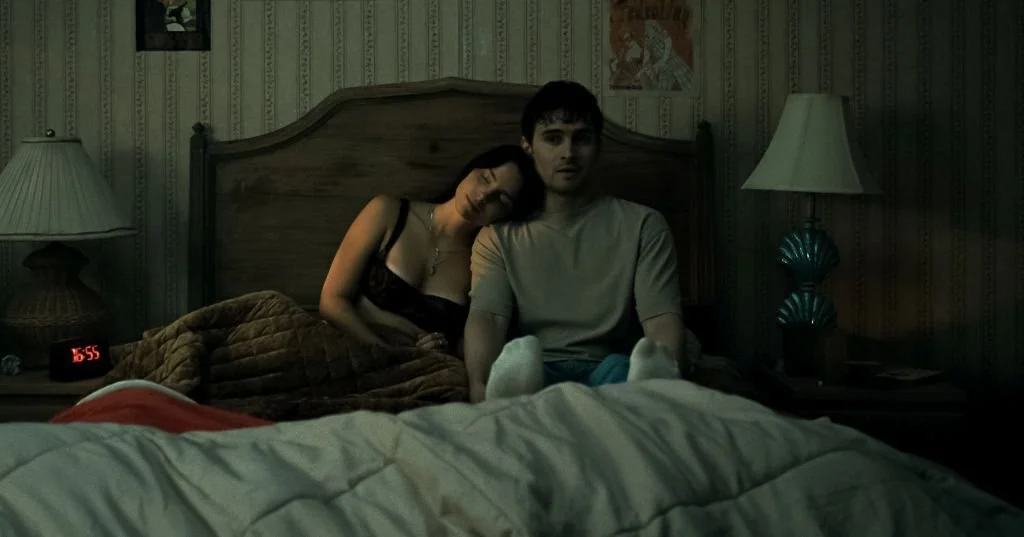
Together, they become the film’s biggest assets. The relationship at the center of Obsession is meant to feel alluring, wrong, sad, and frightening all at once, and both performances are strong enough to hold those conflicting notes together.
The story moves with real confidence
Another major strength is the pacing. Obsession never feels rushed, but it also never drifts. It keeps audiences invested because it understands how to move from one tonal register to another without losing momentum.
That balance is harder than it looks. The film has moments that feel soft, intimate, even strangely romantic (or at least presented that way for its diabolical perspective), and then it pivots into something much more suffocating without seeming to overextend itself. It never lingers so long in one mode that the tension evaporates, and it never charges ahead so aggressively that the emotional logic gets lost.
That sense of control gives the story a satisfying rhythm. The film can take a quiet beat, then sharpen it. It can let a scene breathe, then turn it slightly until it feels dangerous. Because of that, even its smaller scenes carry weight, and there is always a sense that something is shifting beneath the surface.
A clever twist on the wish-horror setup
At its core, Obsession is working with a monkey’s paw scenario, but it does enough with that framework to make it feel fresh and worth investing in. The setup is recognizable: a desire is expressed, the wish is granted, and the consequence turns out to be far more corrosive than expected. What gives the film extra bite, though, is how specifically it ties that mechanism to longing, fixation, and emotional entitlement.
The film is less interested in the wish itself than in what the wish reveals. That is what makes the horror feel so intimate. There is a sense of cosmic punishment built into the premise, but Obsession is equally concerned with what happens when desire begins to override another person’s agency.
Barker has even previously said the movie was built around themes of consent and communication, and that focus comes through clearly in the finished film. And regardless of either character’s perspective, the story keeps returning to autonomy, coercion, and the danger of turning affection into possession, doing so in a way that feels intentional and effectively depicted rather than merely provocative.
Those ideas give the film plenty to dig into while keeping it accessible to audiences on a surface level. It works as a crowd-pleasing horror movie and never loses sight of how to entertain, sure, but a thoughtful thematic exploration runs beneath it, giving the nightmare more shape.
The horror works because it stays measured
Visually and tonally, Obsession handles its scares with real care. It is not trying to flatten viewers with nonstop noise. Instead, it works through accumulation.
That restraint is exactly what makes the horror land. Shadows, silhouettes, careful lighting shifts, edits that suggest movement where there may be none, and framing that traps characters inside intimate spaces all give the film a creeping sense of claustrophobia. The contained sets are used especially well. Rooms start to feel smaller. Corners feel watchful. Familiar spaces turn unsafe without the movie having to scream that fact at the audience.
Even the jump scares feel methodical rather than desperate. The tension has been laid first, which makes the release stronger. Because the film is so measured in how it builds unease, its smaller visual choices often end up being more effective than the larger ones. A shape in the background, a shift in posture, a figure held in half-light—those are the punchy genre moments that tend to linger.
Score: 8.5/10
Obsession is a smart, disturbing, beautifully controlled horror film that gets a lot of mileage out of its central idea. Michael Johnston and Inde Navarrette deliver memorable, shape-shifting performances, the pacing stays tight without feeling mechanical, and the film’s handling of desire, autonomy, and intimacy gives its horror a sharper edge. Add in careful camerawork, a creeping visual language, and a wish-gone-wrong premise with real sting, and the result is one of the year’s most effective genre efforts.