
5 Reasons We’re Excited for Zach Cregger’s New Resident Evil Movie
The latest trailer for Resident Evil suggests that Zach Cregger has found a promising way back into one of horror gaming’s most expansive worlds.
Arriving in theaters on September 18, 2026, the film follows Bryan, a medical courier played by Austin Abrams, whose routine delivery pulls him into a rapidly escalating fight for survival. Cregger directs from a screenplay he co-wrote with Shay Hatten, with Zach Cherry, Kali Reis, and Paul Walter Hauser rounding out the principal cast.
While previous Resident Evil adaptations have moved between elaborate action, direct game references, and attempts to rebuild familiar storylines—this new version appears more interested in recreating the feeling of playing the games: moving deeper into dangerous territory, and never knowing what waits around the next corner.
Here are five reasons the new Resident Evil movie has our attention.
It Teases the Tension of Playing the Games
The trailer begins with a relatively intimate form of winter horror. Bryan is isolated on a snowy road, footprints lead into the distance, and every new discovery seems capable of pulling him farther away from safety. The imagery establishes the kind of uncertainty that makes exploration in the games so effective.
Cregger has spoken specifically about translating the series’ survival mechanics to film, including its slower movement, limited resources, and constant awareness of what a character has available. That approach can give the movie the momentum of a campaign without making it feel too mechanically structured, and the progression already feels like something audiences may want to revisit to notice clues, creatures, and details they missed the first time.
An Original Story Leaves Room for Surprises
Rather than placing Leon Kennedy, Claire Redfield, or another established game character at the center, the film introduces Bryan as an entirely new protagonist. Still, Cregger has already confirmed (alongside the new trailer footage) that the story exists within the Resident Evil world, leaving the games’ central narratives intact.
That choice gives the movie useful flexibility. Connections to Raccoon City, Umbrella, and the wider outbreak can provide enough familiarity for longtime fans, while Bryan’s uncertain fate creates suspense that would be harder to achieve with a character whose history is already known.
An original lead may also make the film easier for casual viewers to enter. Audiences will not need an extensive understanding of the games to follow Bryan into the crisis, while fans can still watch for the places where his story intersects with established lore.
The Horror Looks Carefully Constructed
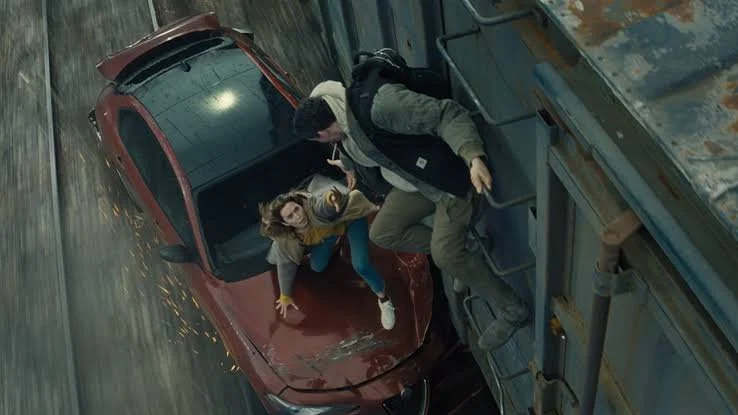
The creatures, sudden attacks, and infected bodies featured in the footage suggest a movie with several different forms of horror operating at once. Some moments rely on anticipation, including Bryan searching an apparently abandoned location. Others push toward grotesque creature design, violent pursuits, and attacks that arrive with little warning.
The trailer also avoids revealing a single dominant threat. Infected people, distorted creatures, underground spaces, open streets, and isolated interiors all appear to carry different dangers. That variety should allow the movie to shift its rhythm without losing the pressure surrounding Bryan’s journey.
The Winter Setting Brings a Fresh Visual Identity
Snow-covered Raccoon City is an immediate departure from the atmosphere most often associated with early entires. As a result, the change gives this version a visual character of its own and makes Bryan’s isolation feel even more severe.
Winter also creates practical opportunities for suspense. Footprints can reveal that someone has recently passed through an area. Empty roads become harder to escape. Blood and movement stand out more sharply against the landscape. Even before the outbreak becomes fully visible, the environment can communicate that its lead is moving through a place where something has already gone wrong.
The film is even expected to move through multiple locations as the night escalates. That progression should bring different degrees of horror, from the exposure of open terrain to the claustrophobia of houses, tunnels, laboratories, and whatever other corners of Raccoon City Bryan is forced to enter.
Resident Evil Still Has Enormous Cinematic Potential
Between the long-running game series and several generations of film and television adaptations, Resident Evil has already proven how many stories its world can support. Its combination of corporate conspiracy, biological horror, survival, action, and memorable creatures gives filmmakers several possible entry points.
Cregger’s involvement makes this attempt especially interesting. After Barbarian and Weapons, he has become one of the most visible contemporary horror directors working at a studio scale. His interest in atmosphere, escalating danger, and unusual narrative choices also feels compatible with a franchise that needs careful handling more than another straightforward recreation.
The new movie could even establish a format capable of expanding without immediately relying on the same characters or retelling the same events. Raccoon City is large enough to contain stories unfolding alongside one another, and Bryan’s experience may represent only one path through a much wider catastrophe.
That possibility gives the film stakes beyond a single reboot. Should Cregger successfully capture the tension, creatures, and forward movement of the games, Resident Evil could once again become a cinematic world worth exploring across different characters, locations, and generations.