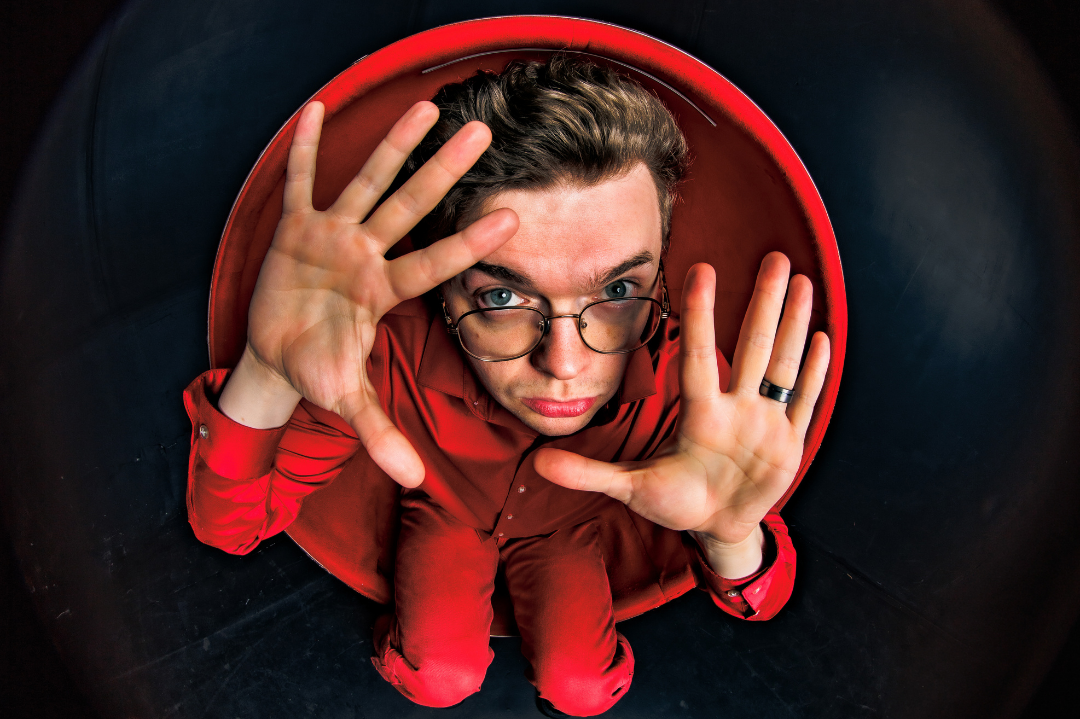

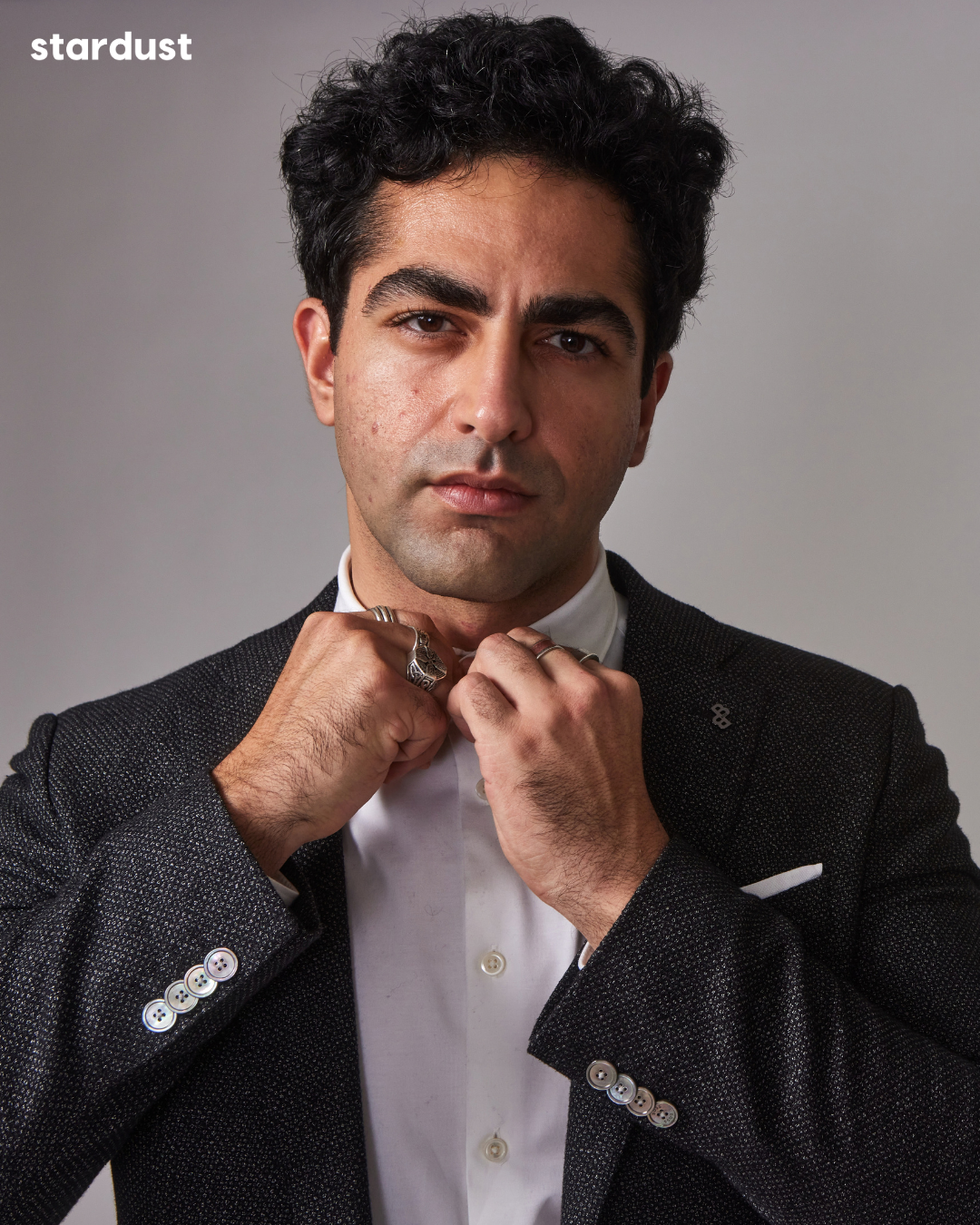
Reza Diako’s approach to acting begins with curiosity—about people, the environments that shape them, and the parts of themselves they rarely make easy to understand. His own life has given him plenty of material to draw from. An Austrian national with Persian and Jewish heritage, Diako spent formative years across Tehran, Vienna, and London before studying psychology and clinical mental health, interests that would eventually become closely intertwined with his work as a performer.
That background has made psychology less of an outside reference point than a recurring part of how he enters a character. Diako is interested in contradiction, private motivations, and the distance between how someone appears and what may be happening beneath the surface. Those instincts are particularly visible in Reading Lolita in Tehran, Eran Riklis’ adaptation of Azar Nafisi’s acclaimed memoir, where he plays Bahri, a literature student navigating a story shaped by political upheaval, intellectual freedom, faith, and an increasingly complicated relationship with the world around him.
His work as Philip in The Chosen has allowed for a different kind of exploration. Diako joined the series in its fourth season, stepping into an established role and ensemble before continuing through The Chosen: Last Supper and the chapters that followed. Staying with Philip over multiple seasons has given him the chance to reconsider the character as loss, faith, uncertainty, and responsibility accumulate—an experience Diako discusses with unusual specificity, from the physical details he carries into scenes to the psychological ideas that have gradually changed his understanding of Philip.
Elsewhere, his career has continued to move through markedly different worlds. After roles in Guy Ritchie’s The Covenant and Netflix’s The Diplomat, Diako will next appear in Channel 4’s The Siege, directed by Lewis Arnold and starring Danny Dyer and David Morrissey. The project adds another character built through research, observation, and a collection of details that might never be obvious to an audience but remain essential to Diako.
Now, in an expansive conversation with Stardust, Diako traces those methods back much further than any one role. He reflects on growing up between countries and cultures, the psychology that still informs his preparation, inheriting Philip from another performer, finding the romantic interior of Bahri, the unexpectedly useful influence of WALL-E, and the kinds of characters he is still waiting for the chance to play.
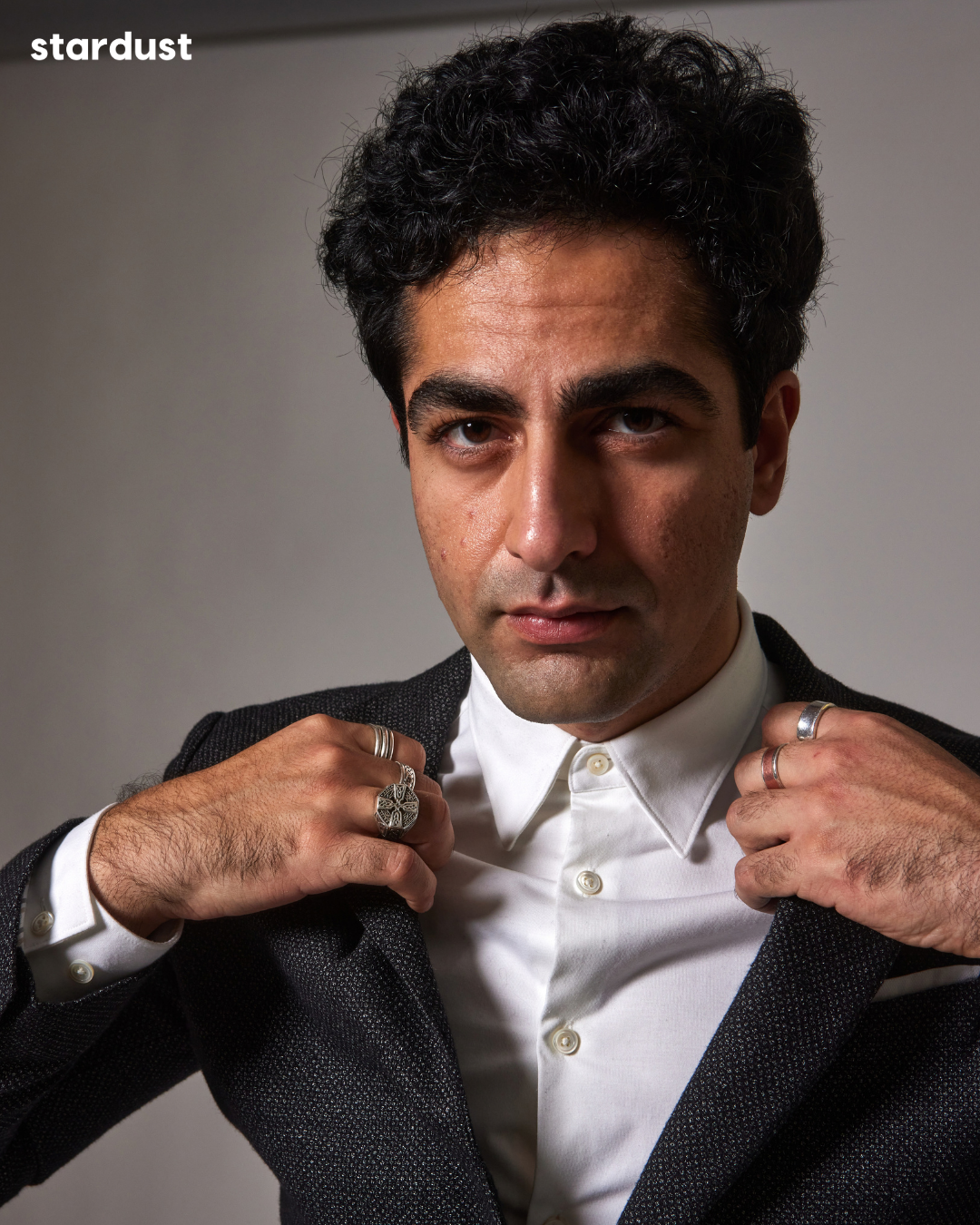

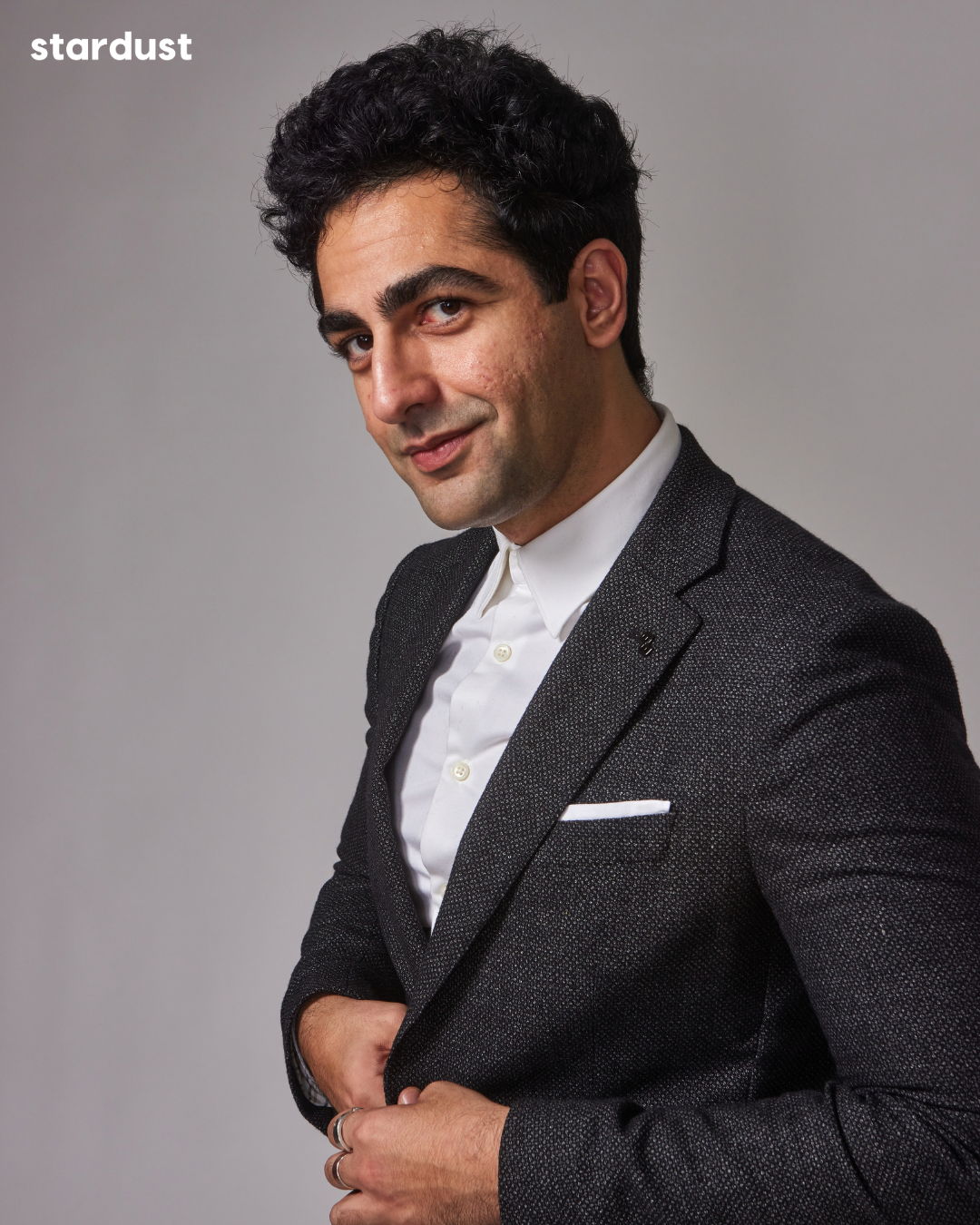
Your path to acting includes living in Tehran, Vienna, and London, as well as studying psychology and clinical mental health. Looking back, how do you think those different experiences shaped the performer you eventually became?
Reza Diako: I think I’ve spent my whole life being thrown into completely different worlds and having to understand the new rhythms and parameters and the people inside them.
I was born in Switzerland and moved to Iran when I was six. It was a huge culture shock. I’d grown up speaking English, watching Disney and Barney, supporting Manchester United, and being obsessed with Digimon. Then suddenly I’m in Tehran, in a much more closed environment, where as children, we were warned by parents to be very careful about admitting that we watched foreign television, listened to foreign music or had certain foreign things at home, or they could be aggressively taken from us by the government.
So, I became quiet. I watched. But I also escaped into imagination. In first grade, I decided I was Tarzan and would crawl around the playground like a gorilla. Then I realized I needed to understand what the other children found cool to relate to, so I started watching Persian comedies to blend in. Ironically, those comedians became some of my earliest influences and still inform my sense of comedy today.
The schools there could also be very rough. My mother protected me and moved me when she felt somewhere wasn’t right. When I was ten, I spent about a month at one school where recess could be quite violent. While the other kids were fighting and kicking each other, I’d take a piece of my mother’s homemade cake, hide in a corner, and talk to a tree. I’d tell him about my day and about my family. Sometimes I’d hold him. He didn’t have a name. He was just Tree. Then I moved schools again, and I didn’t know the last time I’d spoken to him would be the last time I’d ever see him. I still miss that tree. It sounds funny, but in one month he taught me something very important about finding beauty in every corner, surviving in a storm, adapting without necessarily becoming like your environment, and the fact that nothing is permanent.
Then at eleven or twelve, I moved to Vienna, and everything changed again. I went to an international Christian school. My mother was trying to protect us from what she imagined was the “sex, drugs and rock and roll” of Western adolescence. I was deeply moved by and tried to engage with the Friday chapels, Bible study, leading the praise band, all of it. But I also found myself thinking about God and religion differently. I’d experienced one kind of religious certainty and rigid political doctrines pushed on us in the schools in Iran, and now I sometimes encountered another kind, where people were very concerned with whether I believed in exactly the right thing and in the right way. I remember asking my mother why everybody was so obsessed with differences.
She gave me this beautiful answer: Why fight over whether Moses’ staff became a snake, whether Jesus walked on water, who Muhammad chose as his successor, or even proving any of it was real or not? Look at how these human beings chose to live. How did they treat their children, their spouses, strangers, their enemies, the poor, and the powerful? And remember that you’re human too, so you can choose how you live every day and at every moment, just like them.
That completely shaped my relationship with faith and taught me an important lesson. Don’t play battle of the gods. Don’t boast it with ego. Keep it personal and private. Let it quietly seep through the fruits, your behavior. Years later, studying Jung, I recognized something of that again: the mystery, the symbolic, the idea that the sacred doesn’t have to be reduced to an argument you win. It’s present in the simple moments when you choose it or allow it. And art is the same. It’s egoless, a sacred mystery in a co-created moment.
Vienna also gave me this extraordinary cultural playground. My best friend and first crush were both Korean, so naturally I started learning Korean music and flirty Korean phrases. Then I had an Indian crush, so suddenly I was learning Hindi songs and Bollywood dances. My friends were from all over: Taiwan, Bhutan, Costa Rica, the Philippines, Ethiopia, Pakistan, England, Sweden, Mexico, America, Venezuela, Germany, and Austria. We played with each other’s languages and accents, learned each other’s dances and music. It was very rich and beautiful. I suspect that’s partly why my ear became so porous and why I can pick up languages and dialects unusually quickly.
And I also suddenly had access to opportunities I had never had in Iran. I went mad with it! Piano, alto and tenor sax, choir, musicals, football, tennis, basketball, track, languages. I played in the high-school jazz band while I was still in middle school. I sang baritone in the Honour Choir with high-school students from around Europe in Prague, while I was still in middle school. I wanted to learn everything and fast. I think I still work with the same hunger and obsession in my acting roles, because some part of me remembers the children I grew up with who did not and might not ever get those opportunities I have. When somebody gives me access to something, a role where I need to research a new culture, learn a new dialect or skill, I don’t want to waste it, so I always give it my all to push the limits of what is possible.
Then at fifteen I moved to London and had to reinvent myself again. By then I’d experienced the Iranian academic system, an American curriculum, then the IB and eventually A-levels. I once had to catch up with an advanced conversational Spanish class that I’d missed four years of prior preparation for, and with obsession I became fluent within about six months because I refused to accept that I’d arrived too late. I was songwriting, improvising dance routines, training in classical singing, doing theatre. I played Salvador Dalí in Hysteria. Then in my final A-level years I basically became Snape, head down, studying obsessively, because I thought my mission was going to be psychology and eventually creating my dream therapy center.
And I don’t see that part as separate from acting either. Psychology, clinical mental health, medicine, psychodynamics, Jungian depth psychology; they gave language to something I’d been doing instinctively since I was six: trying to understand what is happening underneath people. When you’ve lived in enough cultures, you realize very early that human behavior is contextual. The person somebody appears to be isn’t necessarily the person underneath. Fear changes people. Family changes people. Faith, shame, love—it changes people. Trauma changes people. And people very often say they want one thing while unconsciously organizing their entire life to protect themselves from it.
Clinical work taught me something even more important: don’t rush to explain somebody. Listen with total curiosity. That’s how I approach characters now. I don’t want to diagnose them. I want to understand them so deeply that even the parts of them I dislike make emotional sense from inside their reality. And then my mother, who’s a painter, gave me perhaps the simplest acting lesson of all. When I was young, she’d tell me: “When you draw a line, mean it. Don’t make lots of little lines trying to make it perfect. Let it be wonky. Let it be weird. Let it be strong. Let it be yours.” I carry that everywhere. Do all the psychology. Do all the research. Learn everything you can. But eventually the camera rolls and you have to draw the line. Your line.
With your background in psychology, when you first encounter a new character, what are you most interested in understanding about them before you begin thinking about how to play them?
Reza Diako: C.G. Jung is very important to me. I’m always curious about the transcendent or archetypal story underneath the literal one. Stella Adler talked about this idea of transcending the circumstances to their highest level rather than reducing everything to our own stupid, boring little lives. As an actor who loves transforming and building complex and different characters, I love that. What is this scene really about at its highest human level?
Then I go in the opposite direction and look underneath. The shadow. Defense mechanisms. What is this person protecting? What are they presenting to the world, and what current is actually moving underneath? I draw from Winnicott, Melanie Klein, Alexander Lowen, Yat Malmgren, psychodynamics, my own therapy, different things for different characters. Some of it is psychological, some physical, some completely unconscious.
I often start with the end and draw the ladder backwards. Who does this person eventually become? What are they searching for without knowing they’re searching for it? What are they running from? What part of themselves have they had to bury in order to survive? With Philip, for example, one of my first questions from scripture was his own: Where is the Father? I knew where his story eventually goes: he leaves everything again, travels into the unknown, and lives a life of service. So I went backwards. Why was this young man willing to leave the safety of home and follow John the Baptist? Why wasn’t the ordinary life enough? I started imagining that one of Philip’s deepest fears might be living an inauthentic life of pure practicality. Becoming a machine. Business, fishing village, nickels and dimes, work, survive, repeat. And the contradiction is that practicality is one of his greatest gifts. When thousands of people need feeding, Philip is the one doing the maths. The thing he’s brilliant at is also part of his shadow: the life he’s frightened of might swallow him.
Then there are the physical objects around a character. I’m fascinated by what Winnicott calls transitional objects, how apparently ordinary things can become psychologically charged. Philip inherited a necklace from John the Baptist, so every now and again, particularly when he was in doubt, I would hold it or quietly meditate with it. His headband became practical rather than decorative: something he’d wear outdoors in the heat and on missions and take off when he was safe to be vulnerable indoors. And as he became more inward in later seasons, I specifically asked costume for longer cloaks and blankets that could almost become another protective layer around him, like an armor of solemn wisdom. For The Covenant, I carried a tiny Qur’an and a piece of a necklace from someone I imagined Haadee had loved and lost. The object was also from someone personal to me and very charged. Nobody watching the film needed to know the history I’d created around those objects. I needed to know. That distinction is important to me. I can build an enormous amount underneath somebody, but I don’t want the audience watching my homework. I don’t even particularly want them to know where the work ends and instinct begins.
I try to find what I call a handshake between myself and the character, some shared human suffering or longing where our inner worlds can meet. Therapy has helped me unknot enough of my own inner world that I can hopefully make myself available to lives very different from mine. I believe enormously in the power of circumstance and choice. Under radically different circumstances, human beings are capable of becoming almost unrecognizable versions of themselves. Acting lets me investigate that without standing outside the character and judging them. And then I surrender to them a little.
Every character gets their own playlist, so Spotify must be completely confused about who I am. My weight, hair, gym routine, sleep, diet and energy can change from job to job too. It’s funny because people sometimes assume the person they meet on set is just me. On The Covenant, I was living at this beautiful resort in Alicante, but I’d be sitting behind closed blinds watching war footage, studying Afghan history and talking to Afghans as part of my preparation. People thought I was intense and shy. On The Siege, I learned to make Persian coffee, started having everybody over every weekend, feeding them and making coffee for them. Suddenly everyone thought I was a generous extrovert. On Reading Lolita in Tehran, I was privately praying, constantly reading literature and carrying myself quite differently around the women. On I Hate Suzie, I was playing a comedian, everybody was laughing, and suddenly I was apparently the funniest person alive. And on The Chosen, depending on who you ask, apparently, I’m either narcoleptic or incredibly Zen because I’ll sleep anywhere, and work hard throughout filming windows to build a surrendered and grounded spirit, connected to the natural world around me.
I find that quite funny. They’re all me. I’ve just moved different parts of myself towards the light. But once I arrive at my trailer in the morning, eventually all the theory has to disappear. I put on that character’s playlist, do an energetic warm-up designed to make me loose, vulnerable, active and present, do a special meditation of letting go of Reza and ego, and then try to become an open vessel. For the other actors. For the director’s vision. For an object I hadn’t noticed before. A change in the weather. Something different in the set. Something my scene partner suddenly does that they’ve never done before. Because after all that preparation, I need to let instinct take over. I want everything to be able to hit me. And then I simply respond.
Reading Lolita in Tehran explores identity, literature, freedom, and political change through a story with deep cultural and historical roots. What drew you to Bahri, and what became most important to you in finding your way into his perspective?
Reza Diako: Bahri really got under my skin because I didn’t experience him primarily as a political character. I experienced him as a deeply romantic one.
When I was preparing, my mother showed me old albums from around her university years in Iran, around the revolution. She told me about a young man she knew who was a devout Muslim, but his faith was deeply personal and almost Sufi rather than about power or government. He was in love with her, and once told her that if she married him, he would treat her like every page of the Quran. I found that so beautiful, and a direct inspiration for Bahri. I read the Quran and started praying daily as I imagined he would, privately, trying to find the sanctified peace he might have found there. That peace and love became part of the private fantasy I built for Bahri and Azar. Somewhere inside him, beneath everything he’s required to be in that particular time and place, perhaps there’s this other world where he could love her in that sacred way.
Because the contradiction in Bahri fascinated me. In the book, Azar herself seems to wonder: why does this Islamic Society student keep coming back? He argues with her, tries to convince her, represents ideas she fundamentally disagrees with, and yet he keeps attending her classes, respects her intellectually, vouches for her, and protects her teaching behind the scenes. My psychological way into that was something I think about as the power axis and the love axis. Outwardly, he’s playing a role demanded by the sociopolitical world around him. The power axis says: This is who I’m supposed to be. This is my group. This is the role I have to play. These are the ideas I’m supposed to defend. But inwardly, I found somebody reaching for something romantic and sacred with Azar. The love axis is much quieter. Curiosity. Admiration. Intimacy. The soul reaching toward another soul despite everything telling it not to.
Power and fear are pulling him one way, love another. That’s tragic to me because it’s incredibly human. I’ve seen versions of that conflict in my own life and relationships, and I’ve explored it through my own therapy. We like to say love conquers all. I certainly want to believe that. But one of the tragedies I’ve come to understand is that sometimes trauma, fear, and the structures we’ve built to survive can defeat love, unless we’re brave enough to fight the inner and outer demons and transcend them.
With Bahri I didn’t want to play “the fundamentalist student.” That’s an idea, not a human being. I wanted to find the person who existed before the ideology, underneath it, and perhaps despite it. Azar Nafisi gives these tiny clues that became enormous to me, particularly Bahri’s sideways smile and his intense, wondrous eyes. I became obsessed with his eyes. I wanted them to be longing, filled with stories and romance, almost betraying an interior life that his words and behavior couldn’t always reveal.
And then the literature became another doorway. Bahri is a talented writer in the book, and Nafisi speaks particularly highly of one of his papers analyzing Huckleberry Finn. I read Huckleberry Finn almost upside down while preparing. I didn’t only want to understand it academically. I wanted to understand what a young man like Bahri might find in it. What hit me was the thirst for innocent adventure. Simplicity. Friendship. Play. Curiosity. The possibility of going somewhere simply because you want to know what’s beyond the next bend. Those things became very moving to me because they’re almost antidotes to fundamentalism, power games, and trauma-based entrapment. And that happened with so much of the literature quoted in the book that I was obsessively soaking in while preparing for the film. Through these books I kept finding hope, freedom, love, resilience, the universality of tragedy, and this strange human insistence on continuing to imagine something better even when the world around you becomes smaller.
Eventually I had this image of Bahri as a white dove in a cage. The cage is real. It changes him. It limits where he can fly. Sometimes it even changes how he behaves. It makes him lose a lot. But somehow, privately, he still keeps his ‘dove’-like-ness. That was what I wanted to protect. Not to excuse him or turn him into something simpler than he is, but to keep alive the romantic, curious, sacred part of the human being underneath all that power and fear. That’s ultimately also what moved me about the story as a whole. Literature can survive in these tiny private spaces. Love can survive there. Imagination can survive there. And sometimes that’s where the freest part of a person is still living.
You stepped into The Chosen as Philip during its fourth season, when both the series and its ensemble already had years of history behind them. How did you find your own version of the character while entering something that was already so established?
Reza Diako: I think the first thing was respecting that I wasn’t arriving on day one of a new show. There was already a Philip, there was already a language to The Chosen, these actors had years of history together, and most importantly there was an audience who already loved these people. I didn’t want to come in with this actorly thing of, Right, let me show you my take. I watched the old Philip and blended a lot of his mannerisms into my physicality. But I also knew that if I tried to reproduce somebody else’s performance, I’d always be one step removed from the truth.
Dallas did something very generous very early on: he essentially said, make Philip your own. That’s one of the greatest gifts a director can give you. It meant I could play. I could throw things at the wall. I could make choices that were a little strange, and trust that if something didn’t belong in Dallas’s world, he’d pull me back. That gave me freedom without feeling like I had to fight for freedom. So rather than thinking about replacing a performance, I started thinking about inheriting a human being.
I looked at what was already there. Philip could be playful, practical, a little quirky. There’s this wonderful moment in Season 2 where the disciples are in the middle of something, and Philip is basically asleep. That told me so much. These men aren’t superheroes. They’re living in the wilderness. They’re walking enormous distances, carrying heavy things, sleeping wherever they can, getting hungry and dirty and frightened. And Philip somehow struck me as someone who could accept the immediate gift of the moment. There’s water? Drink. There’s somewhere to sleep? Sleep. There’s a rock? That’s home tonight. I loved that. So, I started experimenting with the idea that Philip makes the wilderness his home. I wanted to touch the rocks, feel the ground, find places he might genuinely rest, let the dust and physical life of that world affect me, even when surrendering that much control could feel risky and frightening to me as Reza.
I never wanted to stand there like a Marvel superhero henchman in biblical clothing, chest out, projecting heroic importance because the camera happened to be on me. I wanted the mess. The sleep-deprived exhaustion, the humor, the awkwardness, the grief. Always leaning towards a bit of controlled chaos, so you feel these people are actually living there and being affected by it rather than arranging themselves into a biblical painting.
When I joined in Season 4, I had another interesting challenge because Philip was quite quiet in the writing. Of course, as an actor, when you love somebody, you always want to explore more of him, especially as there were moments where there was room and relevance. But I never wanted to manufacture importance for Philip or fight the story for attention. My responsibility as an actor was to serve what the writers had chosen they needed from him and had put on the page, and then make sure that, even in silence, he was still living.
There’s a lot of storytelling in silence. Philip doesn’t suddenly stop having a life because the dialogue belongs to somebody else. Sometimes the most interesting question became: What is changing in him while he’s listening? So, I started letting little things accumulate. How he listens. Where he rests. How he relates to the earth around him. What happens behind his eyes while somebody else has the scene. When humor appears and when it disappears. Eventually those things stop feeling like choices. You don’t think, Philip would touch this rock now. You just reach for the rock. That’s when I know I’m finally getting somewhere with a character: when I stop trying to play him and start trusting that he’s already there.
You’ve now been able to stay with Philip as The Chosen moves into increasingly consequential parts of its story. What have you discovered about him over time that you don’t think you could have understood when you first took on the role?
Reza Diako: Surrender. I think that’s the word. When I first came to Philip, I understood so much of him through searching: searching for meaning, searching for the sacred, searching for the Father. But the longer I’ve played him, the more I’ve become interested in what happens to his faith when the answers stop coming in the form he wants them to.
John the Baptist became incredibly important in that respect. John was Philip’s first rabbi; the person he’d already left one life to follow before Jesus. So when John dies, I couldn’t imagine that Philip simply continues unchanged. I remember speaking to Dallas in Season 4 because I felt we needed some acknowledgement of John’s death in Philip’s journey. Dallas listened and gave that relationship a little space to be acknowledged, and that mattered enormously to me because it allowed me to begin carrying a different Philip underneath the familiar one. The jokes can still be there. The quirks can still be there. He’s still useful. But perhaps something in his eyes is more solemn. Perhaps he’s becoming aware that following something sacred doesn’t protect you from losing the people who led you there.
There’s something painful to me about the fact that Philip’s search for the Father seems to keep asking him to love people he cannot ultimately keep. First John, then Jesus. In Season 5, I found some of Philip’s playfulness returning. He’s supporting Peter in leadership; he’s useful again; there’s something of the Philip we know. And then Jesus starts telling them that he’s going to die, and suddenly that Father wound opens all over again.
By Season 6, which comes out soon, they’re entering what I can only describe as oblivion and chaos. There are moments where Philip and the others are watching something horrific unfold around the person they love most, and they’re literally losing the fight. They want to protect him. They want to solve it. They want to do something. And they can’t. That powerlessness was very important to me. I didn’t want to “play emotion” through that. I wanted to play against it. Play the hope. Play the fight. Play the problem-solving. There must be something else we can do. There must be another way through this. Keep searching for the next solution until eventually there isn’t one.
And then what remains? Service. That’s where I started understanding surrender differently. Surrender isn’t giving up. For Philip, I think it becomes almost the opposite: surrendered service. When you can’t control the outcome anymore, you can still ask: Who needs me? What can I do? How do I keep the person beside me going?
There’s a moment in Season 6 I have to be careful not to spoil. We receive destabilizing news about Jesus. Matthew is beside me. There wasn’t much on the page, but I sat next to him and began reciting the Our Father. It just came. It felt like something these men might return to from the more innocent days together, the simple prayer they’d learned early on, the faith they’d shared before everything became so frightening and complicated. Dallas liked what happened, and we later developed it further in ADR. I loved that because somewhere inside that little moment I could suddenly see the future man Philip might become, the person who eventually has to go out into the unknown himself and serve.
You can’t spend your whole life searching for somebody else to be the Father. At some point, you have to become capable of holding somebody else. And as the journey has gone further, some of my Jungian and psychodynamic interests have become useful in ways I couldn’t have anticipated when I started. Jung calls it the Psychoid; Bion has this idea of “O,” ultimate reality, the unknowable unknown. I’m fascinated by that point where intellect has exhausted itself, and you’re left relating to something you cannot control or fully understand. That’s where I found Philip’s conviction: knock anyway. Even when you don’t know what’s behind the door. Even when everything you thought you understood is collapsing. Knock, surrender, serve, and trust that somehow there will be an answer from the divine.
And then in Season 7, which we’ve just wrapped, something shifts again. Philip has spent so much of his journey searching for certainty, and then he witnesses something that makes certainty almost irrelevant: his rabbi has defeated death. If that is possible, what exactly is left to be afraid of? For me, that changed his relationship with the unknown. Instead of needing to conquer it or understand it before stepping into it, he can lean towards it. Give everything he has, a hundred percent, and leave the rest to something above himself. That’s something life has been teaching me too. There’s a point where preparation and effort end and trust begins.
And I think that’s what begins preparing Philip for the man we eventually meet in Acts. The wilderness is about to become much bigger. He will have to leave again, travel into places he doesn’t know, serve people he hasn’t met yet, without the physical presence of the rabbi he once followed. But perhaps by then he doesn’t need to know exactly where the road leads. He’s learned to walk into the unknown.
And strangely, one of the moments that made me feel I’d found something true in him happened completely outside the show. At ChosenCon, a woman came through the line simply to thank me. She told me that Philip’s experience of being an outsider and the father story I’d tried to quietly carry through him had connected with trauma she was working through in her own therapy. She’d also heard me speak openly about therapy and my dream of eventually creating a therapy center, and told me that it had helped inspire her to seek help herself.
She’d brought me a gift so I’d remember her. I hugged her, we took a photograph together, and I wrote her a little note. Then she left, and I cried for a moment before the next photographs. Because you spend so much time as an actor obsessing over tiny things, did that moment work? Did I find him? Did I serve the scene? And then somebody tells you that something you quietly put into a character met something equally private in them.
That’s the point where you remember why any of this matters. If, years from now, somebody thinks of my Philip and remembers surrendering into the unknown, keeping faith and looking up, I’ll feel that I served him properly.
You also have The Siege ahead, which places you in another very different world alongside Danny Dyer and David Morrissey. Without giving too much away, what can you share about your role and what made the project something you wanted to be part of?
Reza Diako: Abbas Fallahi was so much fun because my way into him sounded completely insane. I’d wanted to work with Lewis Arnold for years. I really admired his work, so when I got the part, I wrote him this slightly terrifyingly vulnerable email about my preparation so far, basically saying, “I think Abbas is partly WALL-E and partly the violin trio on the Titanic who continues playing while everything is collapsing and sinking around them.” Then I pressed send and thought, He’s going to think I’m crazy. He loved and embraced it.
What I saw in Abbas from the script was this almost innocent, egoless instinct for service. Pure heart, preservation, busy hands, while tragedy is happening around him. There can be something enormous going on in the room, and part of Abbas is still thinking, Has everyone got their Persian coffee? Does this person need something? I found that incredibly moving and quite funny.
I worked in restaurants and cafés to prepare for his practical hospitality skills. And then the psychology in me inevitably started asking: why is this man so obsessed with Persian coffee? Why does he need and insist on serving everybody? Why is being useful so important to him? As part of my research, I spoke to people, including a close family friend who had worked in restaurants and cafés around that period of the Revolution, both before and after the Shah. He told me this extraordinary and quite painful story about being sent away from Iran by his father, who had contracted him with a restaurant in Italy to work when he was only thirteen. He’d essentially learned as a child that his value was in being useful to other people.
But what struck me was that this same man was also incredibly romantic. He had all these beautiful stories about falling head over heels for love. That contradiction stayed with me. Maybe service isn’t merely what Abbas does. Maybe it’s how he’s learned to understand his value. And maybe, somewhere underneath that, service is also how he understands how to show his love. Nobody watching needs to know any of this. But suddenly the Persian coffee matters. Serving somebody a cup of coffee can contain an entire history of love, survival, and self-worth.
Once Lewis understood what I meant with the WALL-E idea, he really let me play with Abbas having these constantly busy hands. So, while these enormous scenes are happening, Abbas might be making Persian coffee, carrying biscuits, serving everybody, quietly moving through the room. Which then became absolute multitasking gymnastics. I’d sometimes have to serve practically an entire room, do it again and again, sometimes close to fifty takes, remember exactly who I’d already served and what order I’d placed the sugar cubes for continuity, hit my marks, adjust the timing for different camera setups, say the dialogue, and somehow still actually listen and engage with the scene. I loved it because eventually the activity stops being “business” you’re doing for the camera and becomes part of the person. Abbas doesn’t stand around waiting for his line. He’s constantly serving. That’s his state of being.
There was also a moment where I suggested a small change to the text because I felt it could carry a little more of the depth underneath what was happening, something about the revolution, why these people were fighting, and the story we were actually inside. Lewis and Will Smith trusted me with it. And after that there were other tiny adjustments, language, mannerisms, the gentlemanliness of Abbas, little details of service, that they allowed me to bring in.
That’s probably my favorite relationship with a director. Someone with a very strong vision who still leaves enough oxygen inside it for the actor to bring something strange, specific, and personal. And Lewis gave me that.
Between Reading Lolita in Tehran, The Chosen, The Covenant, The Diplomat, and now The Siege, you’ve worked across very different genres and scales. At this stage in your career, what tends to make you recognize a character or story as something you need to pursue?
Reza Diako: Usually there’s something about the person I can’t solve.
If I read something and immediately understand exactly how to play him or feel like the writers expect him to be played as a cliché, a tick-box type, or an idea, I’m probably less interested. I like having that little feeling of, Oh shit. I don’t actually know who this is or how to do this. That’s exciting to me. I’m drawn to contradiction because that’s where I think people become human. Someone incredibly tender who can also be frightening. Someone deeply moral who does something terrible. Someone hilarious who’s actually falling apart. Someone you love and then they do something that makes you think, Can I still love you after that?
I don’t particularly want to play good men or bad men. I want to understand how somebody became themselves. I’ve been very fortunate that a lot of my work so far has existed against enormous external circumstances: revolution, Iran, war, espionage, faith, history. I love those worlds. They’re part of me, and I don’t ever want to run away from them. But I’m equally fascinated by what happens when the circumstances are apparently ordinary. Two people destroying each other in a kitchen can feel as epic to me as a war. You can put me on another planet, and I’ll still want to know why this particular person can’t tell his wife he loves her. I’m interested when the world is specific, but the human being isn’t reducible to it.
I also love specificity. I want to enter a world I don’t already know and have to earn my way into it. One of the great privileges of acting for me is that every role can become a temporary apprenticeship in somebody else’s life. And I love when a role makes demands on parts of my instrument I haven’t used yet. I grew up with classical theatre training, music and dance, and I’ve trained in different sports, personal training, martial arts and combat. So put those things to work, or better yet, make me learn something completely new. Give me a sport I’ve never played. An instrument I can’t play yet. Make me study an entire culture, learn a new language or dialect, acquire a physical discipline, understand a profession from the inside. I’ll happily disappear down that rabbit hole. There’s something in me that becomes slightly obsessive when I’m given access to a new world.
What I love is the moment when all that work stops being information and starts changing your behavior. You learn how somebody actually holds an instrument, throws a punch, moves after years of a particular kind of training, speaks when they’re thinking in another language, prays, cooks, walks into a room, and suddenly you’ve discovered something about their psychology that you could never have found sitting at a table discussing their backstory.
I think I’m drawn to filmmakers in the same way. I love a very particular point of view. I grew up between cultures, and perhaps that’s partly why my taste has always been quite global. I’m as excited by filmmakers like Thomas Vinterberg, Lynne Ramsay, Yorgos Lanthimos, Leos Carax, Magnus von Horn and Ali Abbasi as I am by Charlie Kaufman, Terrence Malick or Robert Eggers. And I love filmmakers like Christopher Nolan and Denis Villeneuve who can bring a very particular cinematic imagination to an enormous canvas. They’re all wildly different, but that’s rather the point. What excites me is when I can feel a particular imagination behind the camera, when the work makes me look at a human being or the world slightly differently than I did before I entered the cinema.
I don’t need that point of view to resemble mine. In fact, it’s probably more interesting when it doesn’t. I want to be challenged by the filmmaker too. Give me strong walls, and I’ll happily play inside them. I love somebody who knows the world they’re creating completely, but remains curious enough to let the actors surprise them inside it. That’s the kind of collaboration I’m hungry for: where I can bring all the obsessive preparation and psychology, but ultimately have to surrender some of my own ideas and enter somebody else’s imagination.
And I like stories that leave a little mystery intact. Maybe that’s the Jungian in me. I don’t need a film to explain everybody to me or tell me exactly what judgment I’m supposed to make about them. Sometimes the most truthful ending to a character is still a question. People are like that. You can know somebody for twenty years, and then they do one thing that makes you realize there’s an entire room inside them you’ve never entered.
So, I don’t think it’s really scale or genre that makes me want something. Give me two people destroying each other in a kitchen, or put me on another planet. Give me a tragic love story, a dark comedy, or a mythic world. Just give me somebody I haven’t solved yet.
If I read it and think, I genuinely don’t know this person, or if I can do this, I probably want to do it.
As audiences continue to see different sides of you through these projects, is there an aspect of yourself as an actor—or a kind of character you’re capable of playing—that you’re still waiting for the right opportunity to reveal?
Reza Diako: Oh God, most of it.
I genuinely feel like audiences have only seen small fragments of me so far. And I’m enormously grateful for those fragments. But perhaps partly because of all the Jungian work and therapy I’ve done, I’ve come to believe that every person contains an entire world. There’s that beautiful Blake image of seeing a world in a grain of sand. I feel something similar about people. However, apparently ordinary somebody seems from the outside, there are memories, contradictions, fantasies, wounds, loves, shadows, entire unlived lives inside them. So, I don’t feel remotely finished. I want to keep expanding the repertoire and take each new person seriously enough to give my mind, body, and soul to discovering them. There are whole parts of me as an actor that I don’t think audiences have met yet.
One of the things I’m most hungry for is actually very simple: let me be a contemporary man where nobody needs to explain where he’s “from.” Somebody brilliant at his job and terrible at being loved. A doctor trying to keep himself together through a fourteen-hour shift. A psychologist who can understand everybody except himself. A failed musician. A husband sitting in his car at three in the morning because he doesn’t want to go home. Somebody getting divorced. Somebody falling catastrophically in love. Somebody who makes you laugh for forty minutes and then suddenly breaks your heart. Let the extraordinary thing about him be his interior life.
I think I feel particularly strongly about that, because before acting became my full-time life, I spent years studying psychology, clinical mental health and medicine, and I was allowed into parts of people’s lives that they don’t necessarily show the world. I spent time around people experiencing psychosis, suicidality, autism, imprisonment, serious illness, and people from completely different socioeconomic worlds across London. Some of those encounters were very brief; some stayed with me. I don’t mean that I want to take somebody’s private suffering and turn it into material. Quite the opposite. It taught me how enormous an apparently ordinary life can be. You can sit opposite somebody for twenty minutes and realize there are generations of love, shame, violence, humor, illness, class, family, and survival sitting in the chair with them. I think I’ve been collecting stories and human beings all my life, across countries, hospitals, classrooms, sets, relationships, and I want the work to give some of that life somewhere to go.
And romance, absolutely. I’m a hopeless romantic, unfortunately. I’ve had nearly two decades of failed love stories across different countries and cultures, some beautiful, some tragic, some completely insane, so there’s a lot in the cupboard. I’d love a sweeping period romance, but I’m just as interested in two people in a room who know exactly where to hurt each other. I’d love to build somebody’s love life as seriously as we normally build their trauma. Why this person? Out of eight billion people, why does this particular human being dismantle you? Are you actually choosing them, or is some old wound choosing for you? What does intimacy awaken that you were perfectly capable of hiding from while you were alone? Love can be incredibly romantic and incredibly exposing at the same time.
And theatre. God, yes. I don’t want people to think of me as only a film and television actor. Some of the first acting that made me fall in love with this was theatre, and there’s something about having nowhere to hide that I miss. Shakespeare, Chekhov, the classics, absolutely, but also a brilliant new two-hander in a tiny room somewhere Off-West End or Off-Broadway where the audience is practically breathing with you. I don’t need it to be a grand production. Give me two complicated people, language worth wrestling with, and an audience close enough that I can’t fake a second of it. I’d love to put all the psychological work and classical training under that kind of pressure again.
And comedy. Please let me be funny before everybody permanently decides I’m a solemn man staring intensely into the middle distance. Which is true some of the time, but not all of the time. This has actually become a running thing on sets. People I work with will ask some version of, “Why aren’t you doing comedy? Tell your team to get you comedies.” My humor can be very deadpan and quite dark, but there’s also this older Persian influence underneath it. When I was seven or eight, I’d sometimes go to sets as a fan and watch performers like Javad Razavian work. I loved the total commitment. He could become playful, childlike, surreal, find a strange voice or physicality, improvise, become completely ridiculous or embarrassing, and never stand outside the character apologizing for it.
I adore Sacha Baron Cohen for some of that fearlessness too. I’ve joked for years that I look like his younger brother, so perhaps eventually somebody can save casting a search. But underneath the joke, that freedom really excites me. I want to be able to become ridiculous without protecting myself from looking ridiculous. Comedy can reveal something horribly true about a person while everybody is laughing.
There’s another part of myself I’m only beginning to understand too. I discovered late as an adult that my maternal family was Jewish. My grandparents were enormously present in my childhood, particularly in Vienna, but because of their experiences and fears around antisemitism, it wasn’t something they had shared with me. By the time I discovered it, both of them had passed away. My grandfather was one of the most important men in my childhood. He taught me chess. He got me into tennis and Nadal. He taught me discipline. He taught me about the true meaning of resilience, patience, and forgiving love. And then, as an adult, I discovered there was this entire history inside somebody I’d loved so much that I hadn’t really understood while he was alive.
I think that’s partly why I’d love to find the right Jewish story one day, almost as a way of walking backwards towards him and understanding something I inherited without knowing it. Man’s Search for Meaning is one of my favorite books. I’d love a story from that world, or something completely different, that lets me investigate what happens to faith, humor, dignity, love, and meaning when somebody is put through circumstances designed to strip those things away. There would be something very personal for me in getting to honor my grandfather through the work while learning the part of his world I didn’t get to ask him enough about when I could.
And I still want the enormous canvas too. Put me inside a dynasty, a criminal family, a war, a strange future, a period world, something mythological. Give me swords, horses, spaceships, politics, violence, whatever belongs there. I don’t think psychological acting has to mean standing quietly and being miserable. I want to know what happens when all that interior work meets scale. Give me somebody with enormous responsibility who is privately terrified. Somebody capable of tenderness and violence. Somebody trying to remain human while the world around him keeps demanding that he become something else.
I’d also love to keep being trusted with languages and cultures that aren’t automatically mine. Strangely, that keeps happening. I’ve been cast in languages I didn’t fully speak and had to work obsessively until the language stopped feeling like a trick I was performing and started belonging to the person. I love that trust. Give me another language. Give me an accent that frightens me. Let me spend months with people from a culture I don’t know yet and discover all the things I was wrong about before I arrived. Having moved through so many cultures myself, there’s something deeply familiar to me about being a humble and curious apprentice in somebody else’s world.
And then I’d love to go properly into the shadow. I don’t mean “dark,” where I grow a beard, wear black, and stare intensely at people. I mean somebody who genuinely tests the audience’s empathy. You understand him. Maybe you even love him. And then he does something that makes you think, Oh God. Can I follow you there? The frightening thing isn’t watching a monster behave monstrously. It’s recognizing yourself in somebody and then watching them cross a line you desperately want to believe you wouldn’t cross.
I think underneath all of these apparently different desires, what I’m really chasing is freedom. When I think about the actors I admire most, I don’t admire them because they discovered their brand and became brilliant at repeating it. I admire the careers I can’t quite reverse-engineer. Someone can carry something enormous and then disappear into a strange supporting character. Be a romantic lead without being frightened of looking ugly or ridiculous. Terrify you in one film and make you laugh in the next. Do Shakespeare and then some peculiar little film nobody quite knows how to describe.
That’s the freedom I’d love to earn. I want to be able to carry a story without having to protect the idea of being a leading man. I don’t want being Persian or Jewish, or British, or Austrian to become the boundary of my imagination. I don’t want seriousness to become the boundary of it either. And I certainly don’t want all this psychology to become another clever cage I’ve built for myself. If the human being requires me to be beautiful, ugly, ridiculous, pathetic, sexually awkward, frightening, tender, heroic, cowardly, great. I want enough freedom to follow them wherever they actually go.
I don’t want success to eventually make me safer. I want it to buy me permission to become stranger.