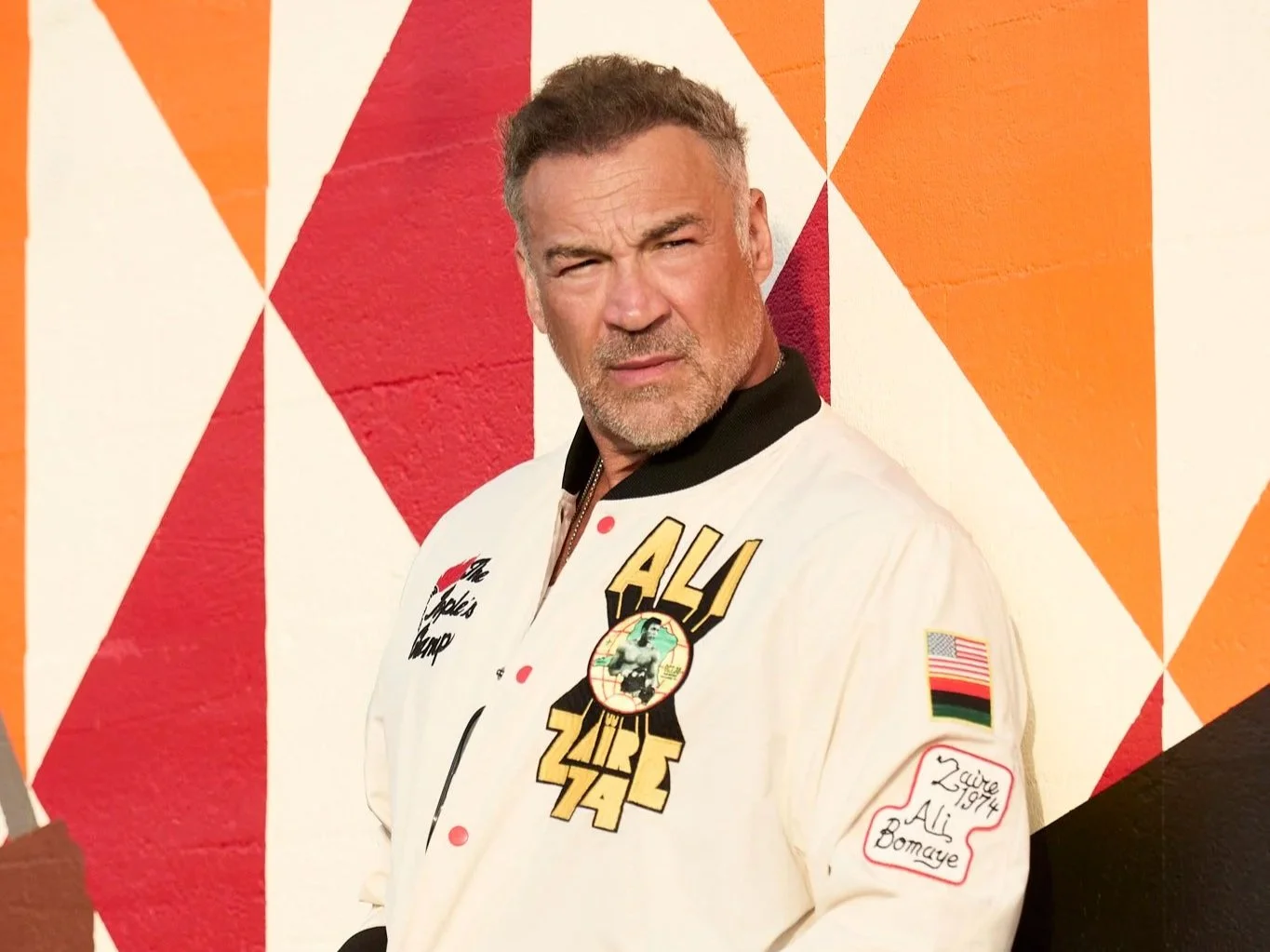

Aleks Paunovic has built a career around presence. At 6'5", the Canadian actor has frequently been called on to inhabit characters capable of changing the temperature of a scene before saying much at all, whether entering Marvel's Hawkeye as Ivan Banionis, stepping into the world of Reacher, or becoming the Cyclops Polyphemus in Percy Jackson and the Olympians. Yet some of the most interesting territory in Paunovic's work has come from looking beyond that physicality and considering what strength actually means once intimidation, size, and spectacle are removed from the equation.
That question carries particular weight in his latest role. Paunovic joins Prime Video's The Greatest, premiering November 4, as William Faversham Jr., a key figure during the early professional career of Cassius Clay, who would become Muhammad Ali. More specifically, Faversham headed the Louisville Sponsoring Group that backed the young fighter and played an instrumental role in connecting Clay with legendary trainer Angelo Dundee. The series places those formative relationships alongside the better-known moments of Ali's life, with Jaalen Best taking on the title role in an eight-episode drama also featuring Omari Hardwick, Dana Gourrier, Giovanni Ribisi, Michael Ealy, and Amin Joseph.
For Paunovic, the project carries a more personal symmetry. He grew up in a family with generations of fighters and pursued boxing himself before a shoulder injury changed the direction of his life—and Muhammad Ali was also one of his childhood heroes. Acting eventually became one reinvention among several, following time as a musician and preceding his more recent work as an entrepreneur and co-founder of Canadian company Legend Water.
Now, Stardust chats with Paunovic about approaching a man who helped shape Ali's earliest professional years, the perspective his own boxing history gave him on the series, separating physical power from emotional strength, and why he has become increasingly comfortable allowing one version of himself to give way to the next.
When did the personal significance of entering this story really hit you?
Aleks Paunovic: There’s something wonderfully strange about seeing your childhood hero become part of your working life. You’re reading a script, thinking about scenes and characters, and then you remember: “Hang on a second, big guy, this is Ali!” The younger version of me would have had a thousand questions. The adult version had to learn his lines. I loved that collision.
What mattered most in understanding Faversham as a person?
Aleks Paunovic: I wanted to find what made him lean forward when Cassius spoke. What interested him? What challenged him? What did this young man bring into his life that hadn’t been there before?
It’s easy to play someone as though they already know they’re part of history. Faversham didn’t have the finished documentary. He had a young fighter in front of him and decisions to make. That uncertainty is where a person becomes interesting to me.
How did your boxing experience shape his relationship with young Cassius Clay?
Aleks Paunovic: Having boxed, I’m interested in what happens after everyone has finished giving a fighter advice. They leave the room, and he’s the one who has to walk into the ring.
That gave me a useful question for Faversham: “Does this young man feel that I’m actually in his corner?” You can admire someone’s ability and still fail to understand what they need. I wanted to explore the relationship underneath the business—the small moments when trust is earned or lost.
What surprised you about Ali’s early career?
Aleks Paunovic: What struck me was how difficult it is to look at young Cassius without letting everything we know about Muhammad Ali crowd into the picture. You have to allow him to be young. To be discovering things. To have a future that hasn’t happened yet. I found that exciting because it gives the audience room to meet him again. We arrive knowing the name, but there’s still a person to discover. And I really think the whole team of The Greatest, from the producers, writers, and actors, really nailed it.
Does playing a real person ask something different of you?
Aleks Paunovic: Yes. A real person gives you an extra responsibility: someone lived this life before you started making choices about it. I enjoy research, but eventually you have to stop carrying your homework into the scene. People don’t speak in footnotes. They want something, they misread each other, they try again. Whether I’m playing Faversham or someone in a much bigger fictional world, I’m looking for that immediate, human problem. The research helps me know where to look.
What lessons from the ring do you still use on set?
Aleks Paunovic: Don’t try to win the whole fight in the first ten seconds. That’s useful advice on a film set, too. When you’re nervous, there’s a temptation to show everything you can do immediately. And believe me, helping tell my hero’s story made me really nervous! lol. Boxing taught me to watch, listen, and let the situation tell me what’s needed. Sometimes the strongest choice is to do less and stay available. Although, thankfully, an acting scene usually gives you a second take if your timing is terrible.
You’ve moved through boxing, music, acting, and now entrepreneurship at different stages of your life. Do you think reinvention has become easier for you over time?
Aleks Paunovic: I’ve become quicker at admitting I’m a beginner. That helps enormously. There’s something quite funny about being a grown man with experience in one field and then entering another where you need someone to explain the basics. Music, acting, business—they’ve all given me that experience. There’s still uncertainty, but I don’t find it quite so insulting anymore. I can ask a question, learn something, and enjoy being surprised.
Looking at The Greatest and everything else you’re building now, what part of your life do you think would surprise the younger version of you most?
Aleks Paunovic: That I’d grow up to be this interested in people. Young me probably would have asked about the fights, the roles, and whether we got to meet anyone cool. I’d want to tell him about the conversations. The people whose generosity changed a day, or whose belief opened a door. And yes, I’d tell him we got to be part of an Ali story. I suspect that’s where he’d stop listening and start grinning.