
28 Years Later The Bone Temple Review: A Smart, Scary Crowd Pleaser
23 years after 28 Days Later first turned sprinting infected into a modern horror language, 28 Years Later: The Bone Temple arrives with the rare sequel flex: it has something new to say, and it says it loudly. Throughout the blood-soaked ride, Nia DaCosta’s entry is gnarly, funny in unnerving ways, and strangely moving, becoming the kind of follow-up that makes you remember why this series still matters when so many zombie stories blur together.
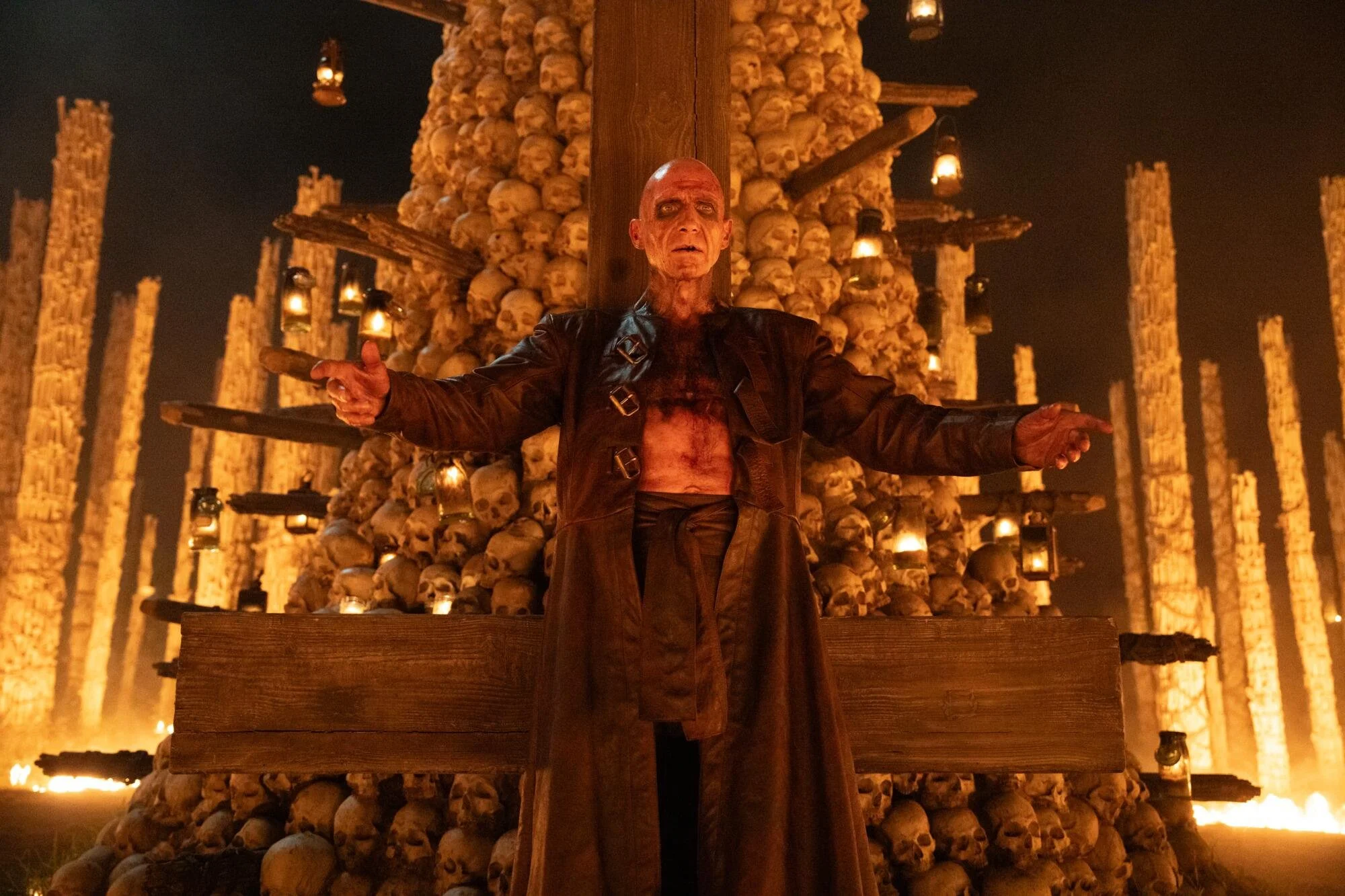
28 Years Later: The Bone Temple | Photo Credit: Columbia Pictures
The Kelson and Samson Curveball
The smartest gamble The Bone Temple makes is giving the franchise an emotional center that has nothing to do with a safehouse siege or a last-minute betrayal. Ralph Fiennes’ Dr. Ian Kelson has been living alongside the dead for so long he’s practically a museum curator of collapse, and the film lets him exist in a register that’s equal parts tender, cracked, and quietly ferocious.
Then comes Samson, the Alpha infected, a figure the movie treats like a myth. Their relationship is the film’s great tonal trick by pivoting between a sense of calm without being soft, intimate without being sentimental, and creepy without leaning on cheap “look, the monster has feelings” beats. More importantly, Kelson’s scenes essentially nudge the franchise toward evolution, hinting that the Rage Virus might not be a permanent sentence. That idea alone feels like an earthquake under the series’ feet, and DaCosta stages it with patience, letting small shifts in behavior land like plot twists.
It also creates a killer juxtaposition with the rest of the movie. While one storyline finds a warped form of companionship, the other drops a teenager into the worst version of humanity’s “adaptation.”
Spike, the Jimmys, and the Violence of Belonging
On the other side of the film is Spike, still played with bruised-open vulnerability by Alfie Williams. The first 28 Years Later positioned him as a kid trying to understand the rules of survival. Though the Bone Temple makes him confront something uglier: a darkness solely rooted in humanity.
Spike’s forced proximity to Sir Lord Jimmy Crystal and his roving cult, the matching tracksuits, the rotating cruelty, and the faux-spiritual rationale for atrocities is a franchise swerve that’s nastier than any infected chase. Still, the point isn’t simply that humans are the real monsters; you’ve heard that sermon. DaCosta’s film is sharper. It’s about how quickly “community” becomes a tool, or even how easily a scared kid can be pressured into wearing someone else’s identity just to survive.
Williams is key to why the storyline works, because Spike never turns into an action hero. Even when he’s moving through danger, you can feel the hesitation, the moral nausea, the constant recalculating of what it costs to stay alive another hour. That unease keeps the violence from turning into empty spectacle, even when the movie goes big.
DaCosta’s Edge
DaCosta’s best move is refusing to treat “taking over a legacy sequel” like a homework assignment. She doesn’t mimic Danny Boyle so much as she speaks in conversation with him, taking the franchise’s adrenaline and grafting onto it a more gothic, sometimes absurdist sensibility. The result feels deliberate, controlled, and still unpredictable, which is a tough balance for a series built on chaos.
That’s a big ask in a franchise this specific. When a series is so tied to one creative team, handing a middle chapter of a new trilogy and the fourth film overall to a new filmmaker is a tricky needle to thread. Luckily, it pays off — audiences are in good hands.
A Middle Chapter That Still Feels Whole
As the second installment in the new trilogy, The Bone Temple has a lot of narrative responsibility. It needs to broaden the world, deepen the mythology, and keep the franchise’s long-game pieces in play. It does that without turning into a two-hour trailer for the next one. The film works as its own contained descent, with two distinct story engines that eventually grind into the same nightmare space.
It also understands something many franchise entries forget: “setup” is only satisfying when the present story hits hard. Here, the stakes feel immediate, the character arcs land, and the lingering questions feel like an aftertaste rather than a missing meal. Even the nods to what’s coming next, including the renewed presence of Jim in this era of the series, read as narrative punctuation as opposed to the standard fan-service clutter.
By the time the credits roll, it’s tough not to put The Bone Temple in the top tier of the franchise. It has heart, it commits to the horror, and it’s got that forward momentum the series needs. The mythology expands without feeling like homework, the cast gets real space to shine, and it ends up feeling like the kind of modern zombie story that actually has something at stake.
Score: 8/10
28 Years Later: The Bone Temple is one of the more confident, inventive, and watchable zombie films to come along in a while.