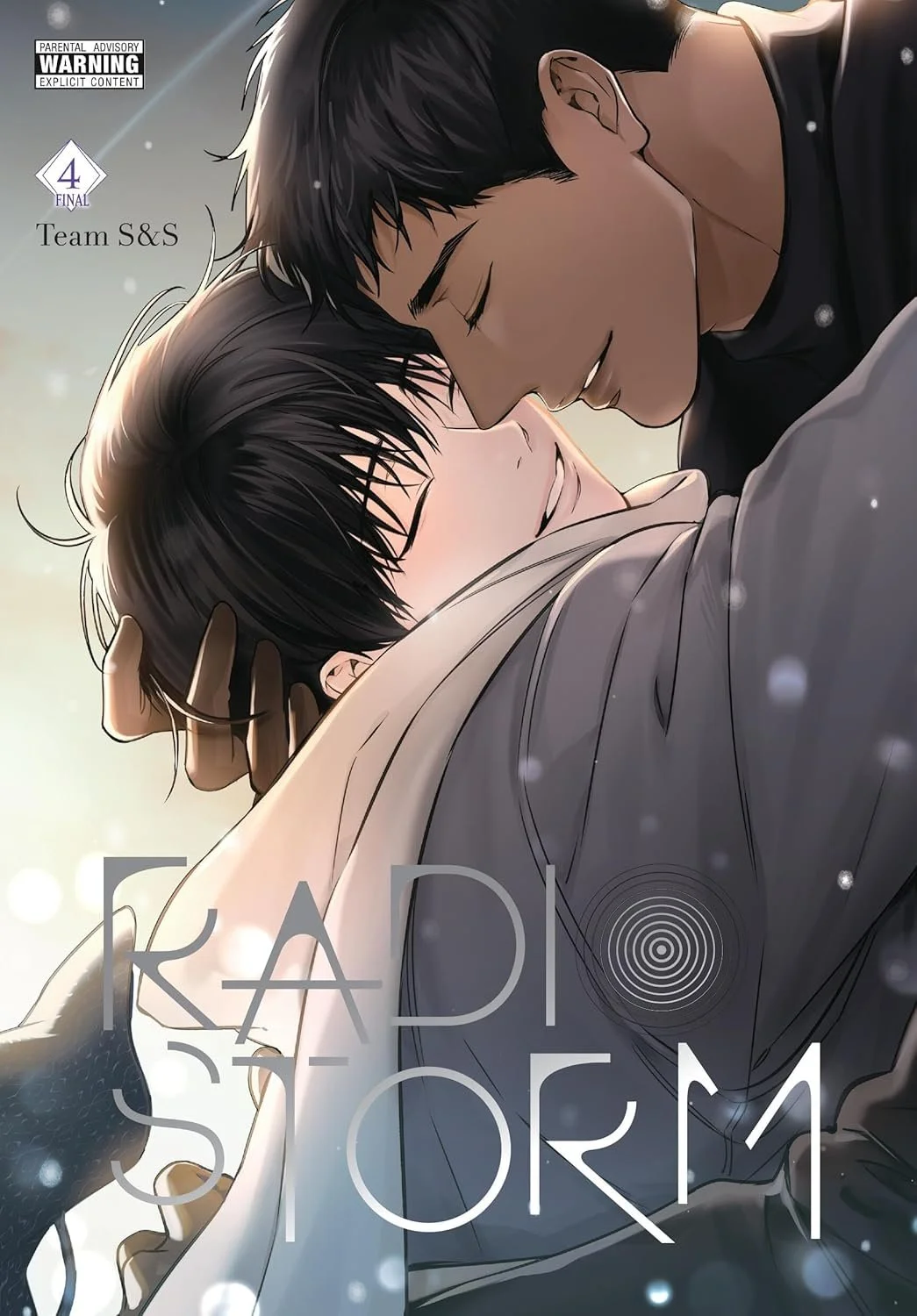

Radio Storm: Vol. 4 Review
Radio Storm, Vol. 4 arrives with both a wrap-up and a rug-pulling out from under the one comfort the series has been letting Sak believe in. And in ways, the ending hinges on a cruel, elegant question. If your love was engineered as compliance, what’s left when the mechanism breaks? This is the final volume in the story’s four-book arc, and it leans into resolution with a tone that stays stubbornly romantic even when everything around the couple is built to dehumanize them.
Plot
Vol. 4 opens with Lima carrying knowledge that changes the rules. He and Sak aren’t the destined partners he thought they were, and that discovery pushes Lima into riskier, more impulsive choices. And with the transmitter broken, Sak is now on a countdown to realize that his devotion may have been an illusion designed to keep him obedient as a weapon.
That’s where Vol. 4 gets its bite. Escape is still the surface plot, but the real suspense is emotional. Can Sak’s attachment survive the revelation that it might have been planted, tuned, manipulated. The story commits to that fallout rather than rushing past it, letting betrayal, grief, and stubborn longing occupy the same page.
Characters
Sak has always been the series’ soft center, and the finale makes that softness feel dangerous. He’s the kind of character who wants to be useful, and in some capacity, wants to matter—but Vol. 4 turns those instincts against him, because he’s now stripped of something that brought the pair close while also in a position where he’s relying solely on Lima.
That being said, Lima’s arc is the one that most clearly “stays” through adversity. His volatility reads less like attitude and more like fear in motion. The more he officially understands the inner workings of those opposing them, the more he refuses to play along, even when doing so risks his own life. He gets more urgent, more exposed, and more protective in a way that finally feels unambiguous.
What lands best is that the finale doesn’t offer a completely clean ending, but it’s still a sincere one. There’s the fact that they’re on the run, Sak is barely recovering from a life-threatening wound, and an easy journey ahead isn’t guaranteed. Still, their undeniable bond manages to survive because it’s chosen again by both.
Art
This series has always looked sleek in a way that somehow feels hostile. Clean corridors, controlled environments, dark shadows with a character focus. Vol. 4 benefits from that established visual language because the plot is about interpersonal intensity at its tipping point (especially through the final chapters and epilogue).
The finale also leans heavily on micro-expression and spacing. It needs the subtle distance between Sak and Lima to communicate as loudly as dialogue. Those are the beats that sell betrayal without turning it into melodrama. And with a longer epilogue, the story has even more room to let those visual beats breathe instead of sprinting to the finish.
Themes
Vol. 4 makes the series’ central theme unavoidable. Love and control are not metaphors here. They’re infrastructure. If affection can be manufactured to keep a core user compliant, then the romance becomes a fight for personhood and survival.
It also sharpens the series’ obsession with worth. The academy’s worldview is transactional, and the finale forces the question Vol. 3 was already circling. Who gets to decide what a life is for. Who gets to decide what “saving” someone means when the saving comes with strings.
The bittersweet part comes from the way the story frames endurance. And the final volume essentially boils the ending down to one desire, no longer questioning the cruelty of the world, just wanting to stay together for whatever time is left. That’s the emotional thesis of the finale. Not idealism. Not purity. A decision to keep choosing each other inside a system designed to strip choice away.
Verdict
Radio Storm, Vol. 4 delivers closure without pretending the world ever becomes gentle. And as a final volume, it’s exactly what it should be. Resolution with bruises. Romance that survives because it refuses to be convenient.