
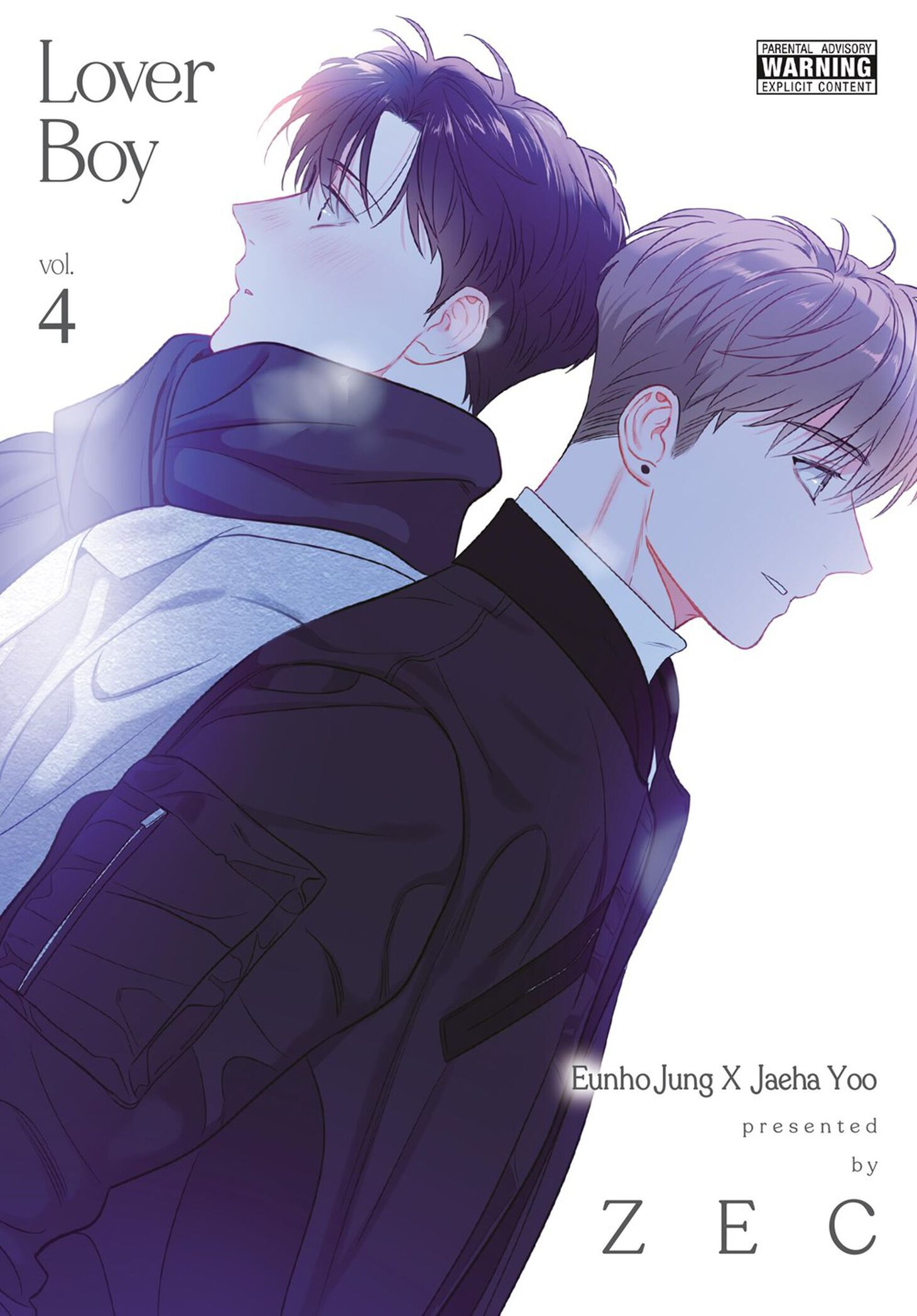
Lover Boy: Vol. 4 Review
Lover Boy, Vol. 4 is the latest English print volume of ZEC’s Boys’ Love romance, published by Yen Press under its Ize Press imprint. And this time around, after a two-year gap since Eunho and Jaeha last saw each other, fate drops them back into the same orbit. So, the volume’s core question is blunt—will it work this time?
Plot
The series’ central tension has always been timing: a long-held crush colliding with adulthood and all the baggage it brings. Volume 1 frames the premise plainly—Eunho Jung has carried feelings for his neighbor Jaeha Yoo since childhood, reconnects with him while in college, and tries to turn that history into something real after Jaeha’s marriage ends.
By Vol. 2, the story leans into the messy middle: they’re together, but the relationship doesn’t automatically arrive with clarity or security. More along the lines of a “friends with benefits” scenario with Jaeha guarded and an ex (including Jaeha’s ex-wife, Hyesun) re-entering the picture.
Vol. 3 raises the emotional temperature through family pressure and self-doubt—Eunho’s mother and sister show up unexpectedly, and Jaeha’s insecurities begin to shape the couple’s first trip together.
Then Vol. 4 swings the hinge—two years have passed since the leads last saw each other, and they meet again by chance—explicitly echoing the “reunion spark” that started their romance in the first place. The hook is simple and sharp: will it work this time? Generally speaking—well, it’s still complicated, but things are headed in the right direction.
Characters
What makes Lover Boy durable across volumes is that its conflict is character-forward rather than plot-gimmick driven. Eunho is written as someone who keeps choosing the same person, even when the shape of that relationship shifts—childhood longing in Volume 1, tenuous intimacy in Vol. 2, and a more fragile kind of closeness in Vol. 3.
Jaeha, meanwhile, is positioned as the story’s emotional weather. He’s the one who’s loved, pursued, waited for—and also the one who keeps finding reasons to hold parts of himself back, whether that’s because he still sees Eunho as “the kid next door” early on, or because old ties and family encounters leave him second-guessing what he deserves.
Vol. 4’s time jump gives these dynamics time to shift, evolve, and showcase how things can (possibly) be different this time.
Art
Across Lover Boy, ZEC’s visuals do a lot of the emotional lifting in ways that fit the story’s push-pull dynamic. The English edition is primarily black and white with occasional spot color, which gives the series a clean, intimate baseline while still allowing key moments to “pop” without turning the whole book into a spectacle. That restraint matters for a romance built on lingering history. The quieter pages can stay quiet—and when a scene needs emphasis, the book has a visual lever it can pull sparingly.
The character art leans into readability and micro-expression—eye lines, small shifts in posture, the way someone’s mouth tightens before they say what they mean. In a story where so much of the conflict is internal (hesitation, doubt, wanting to be wanted), that clarity helps the tension feel immediate rather than melodramatic. The layouts also tend to favor close proximity—frames that hold on faces and hands long enough for you to feel the beat between “I’m fine” and “I’m not,” which is basically the series’ native language.
And Vol. 4’s reunion setup is exactly the kind of scenario this art approach is built for. Visually, that kind of re-encounter is all about tension you can’t talk your way out of—the split-second recognition, the instinct to step closer even when your brain says don’t, the awkward distance that still feels charged. Even when the characters might want to shut it off, the bond reads as physical—something that shows up in every way possible through the Lover Boy art.
Themes
Across Lover Boy, the story keeps returning to a few steady ideas. For example, there’s the ‘right person / wrong time’ setup as an active, ongoing problem—not a one-volume obstacle that disappears once the couple gets together.
The series also has a real capacity for exploring what it looks like to stay emotionally guarded out of necessity. Jaeha’s “walls” and self-doubt are treated as real forces with consequences, especially when family dynamics enter the room.
And then there’s the constant friction between fate and choice. Vol. 4 frames their re-encounter with that fated, pulled-together feeling, but it undercuts any easy romantic certainty with a sharper focus on what they do next, and whether they’re willing to meet each other with the kind of honesty the past never required.
Hovering over all of it is the series’ mature label, which accurately implies that the story is aimed at an older teen/adult audience and isn’t shying away from complicated relationship terrain.
Verdict
On paper, Lover Boy, Vol. 4 has the potential to be the pivot point a romance like this needs. The relationship isn’t brand-new anymore, the early “chase” phase has already played out, and the story is willing to ask what happens after distance and time do their work.