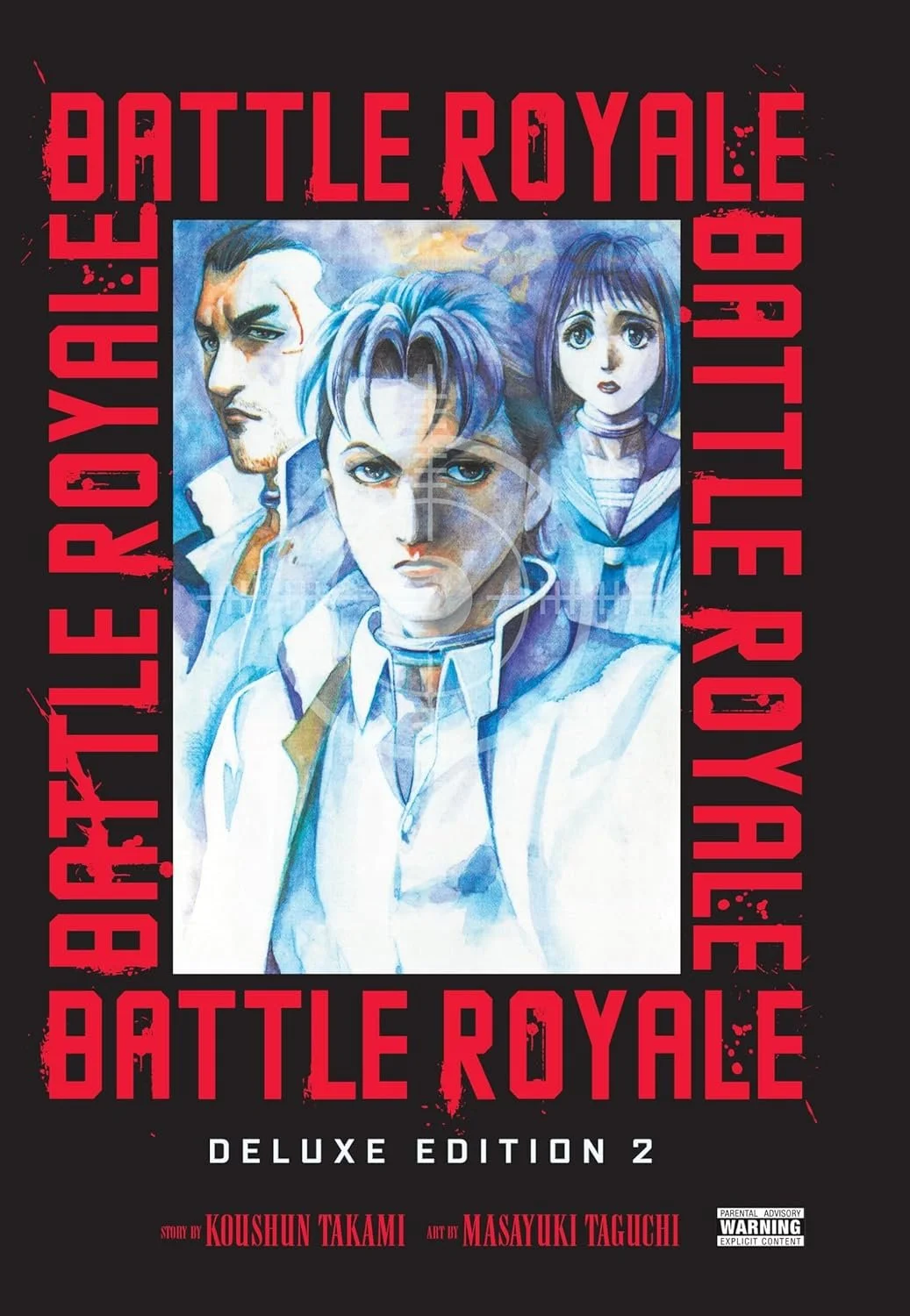

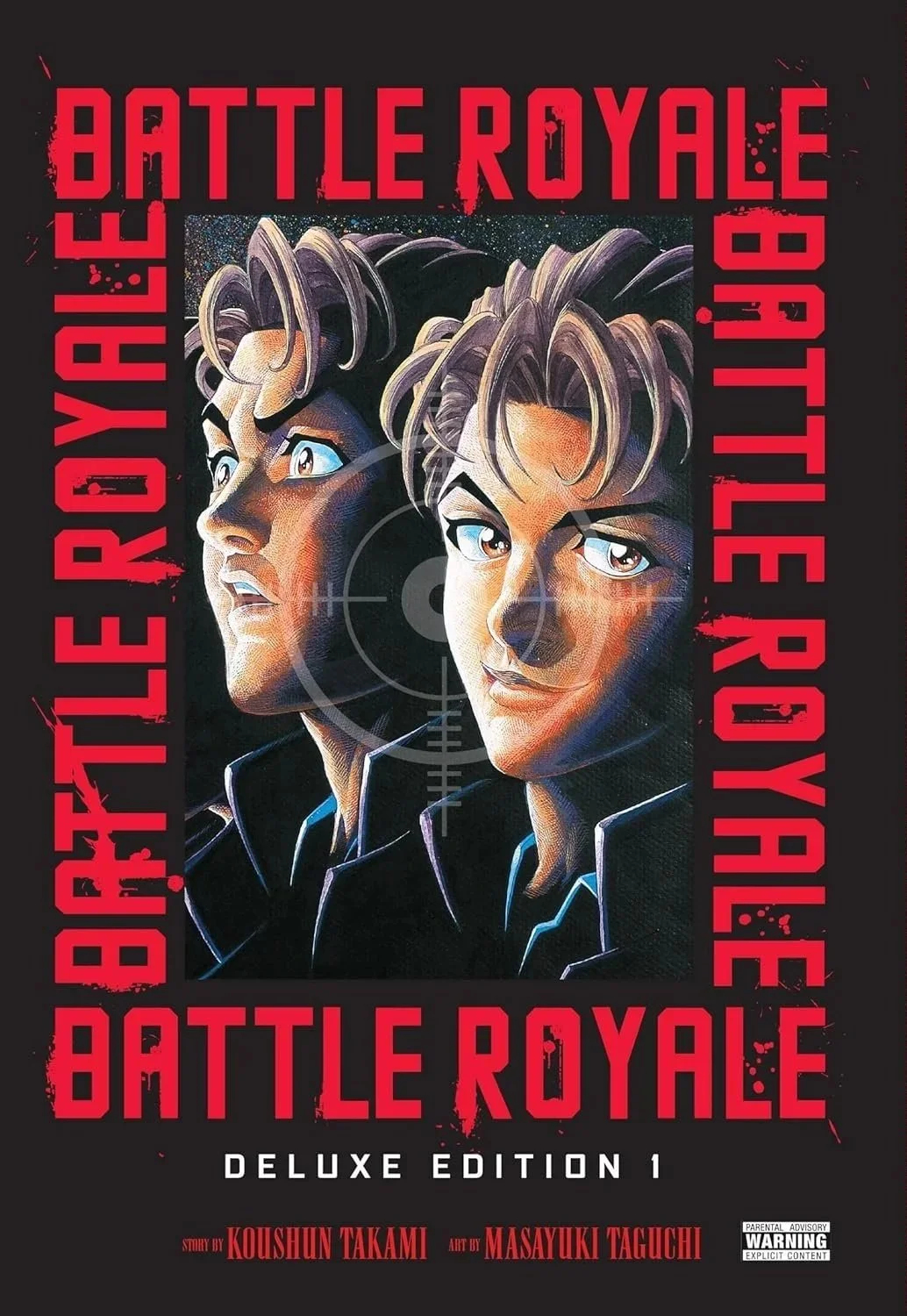
Battle Royale doesn’t need much mythmaking at this point. Koushun Takami’s premise (adapted here into manga form by artist Masayuki Taguchi) helped set the template for a whole corner of modern dystopian pop culture. What Battle Royale Deluxe Edition Vol. 1 offers is the chance to fall back into that opening plunge in an oversized, 600+ page hardcover package from Yen Press.
Plot
The setup is brutally efficient: forty-two junior high students are drugged on a class trip, wake up under guard, and are informed they’ve been selected for “the Program,” a state-run exercise where they must kill each other until only one remains. Each student is fitted with an explosive collar to enforce the rules, and the island they’re dumped on is carved into shifting danger zones designed to keep them moving and colliding.
Vol. 1 (of the new, collector-worthy edition) is all about ignition. It spends time on the shock of the announcement, the denial that curdles into panic, and the way fear rearranges a classroom’s social physics in minutes. The first deaths don’t land as “action beats” so much as proof-of-life for the concept, as it becomes overtly clear that the Program is real, the adults are serious, and whatever ethics these kids brought with them are about to be tested at speed.
What makes the large stretch compelling is how quickly it becomes more than a numbers game. The volume tracks the messy birth of alliances, the snap decisions that create enemies for life, and the small misreads that turn fatal. Even when you know the premise, the pacing stays tense because it’s driven by human error: who trusts too easily, who overcorrects, who mistakes silence for safety. By the time the volume settles into its rhythm, the island already feels like a machine built to convert personality into outcome.
Characters
A cast of forty-two sounds like an intentional blur, but Battle Royale has always been unusually invested in specificity. The book’s central emotional line is anchored by Shuya Nanahara and Noriko Nakagawa, with transfer student Shogo Kawada adding experience and grim pragmatism to their orbit. Around them, the class splinters into recognizable survival “types,” yet Taguchi keeps slipping individuality into the margins: a throwaway expression before a choice, a private memory that explains a public act, a moment of tenderness that doesn’t survive the next page.
The antagonists don’t read as moustache-twirlers, either, even when their actions are monstrous. The volume introduces students whose capacity for violence feels latent, waiting for permission, and others who treat the Program like a stage where they can finally control how they’re seen. You can also feel the series’ interest in leadership under pressure; charisma becomes dangerous, competence can make someone a target, and “doing the right thing” rarely aligns with “staying alive.” Even so, the story makes its moral ugliness impossible to miss—fear and brutal conditions keep shoving people toward choices they’d never recognize as their own, until survival starts to feel like the only rule left.
Art
Taguchi’s art is the engine that keeps the story from becoming purely conceptual. His linework is dense and physical, especially in faces. Panic looks different from terror, and terror looks different from resignation. That matters in a story where the biggest turns often happen in a second: a glance that becomes a decision, a flinch that becomes a tragedy.
Action is also staged with a clear sense of geography. The island doesn’t feel like an abstract arena—it feels like terrain with cover, sightlines, bottlenecks, and bad luck. When violence erupts, it’s legible and vicious, and the manga doesn’t romanticize the aftermath. Bodies are heavy. Injuries change how people move. The mess sticks around. The “Deluxe Edition” presentation also matters here in a practical way. Yen Press brings a larger trim size (7" x 10.13") with a detailed hardcover, which gives that detail room to breathe, especially in wide panels and crowded compositions. A total must-have for new and returning fans.
Themes
At its core, Battle Royale is a story about forced complicity. The Program isn’t simply a death match; it’s a civic lesson delivered at gunpoint. The state creates a situation where survival requires moral compromise, then uses that compromise as evidence that people can’t be trusted. It’s authoritarian logic as a closed loop.
The hefty collection also digs into how quickly violence becomes social. Once the rules are announced and the games begin, the kids fear death just as much as they fear what everyone else might become. Paranoia spreads faster than facts, and suspicion is treated as wisdom because it sometimes is. The tragedy is that the Program both kills students and fractures the idea of “class” as a community (similar to The Hunger Games). Even small gestures of kindness become risky because they can be exploited, misunderstood, or punished by circumstance.
There’s also a quieter theme humming underneath the carnage: identity under surveillance. The collars, the zones, the announcements, the strict rules, the adult observers. Everything is designed to reduce these kids to outcomes. The manga pushes back by insisting, again and again, on interiority. Even when a character makes an unforgivable choice, the narrative is often more interested in how they arrived there than in scoring points about who is “good.”
Verdict
As an opening, re-packaged mega-volume, Battle Royale Deluxe Edition Vol. 1 is lean where it needs to be and expansive where it counts. It sets the rules fast, then spends its real energy on the human fallout—the way friendships warp, the way fear reshapes priorities, the way a classroom becomes a map of fault lines. Taguchi’s art gives the violence weight without turning it into spectacle-for-spectacle’s sake, and the larger-format hardcover framing makes sense for a story that lives in faces as much as it does in shocks.
It’s also emphatically for adults. Yen Press rates it 18+ Mature, and the content earns that warning. But if you can handle the intensity, this edition reads like a strong case for revisiting the original manga as more than a notorious premise: it’s a sustained, character-driven pressure test, and Vol. 1 hits the ground at full speed.