
Jagaaan: Vol. 1 Review
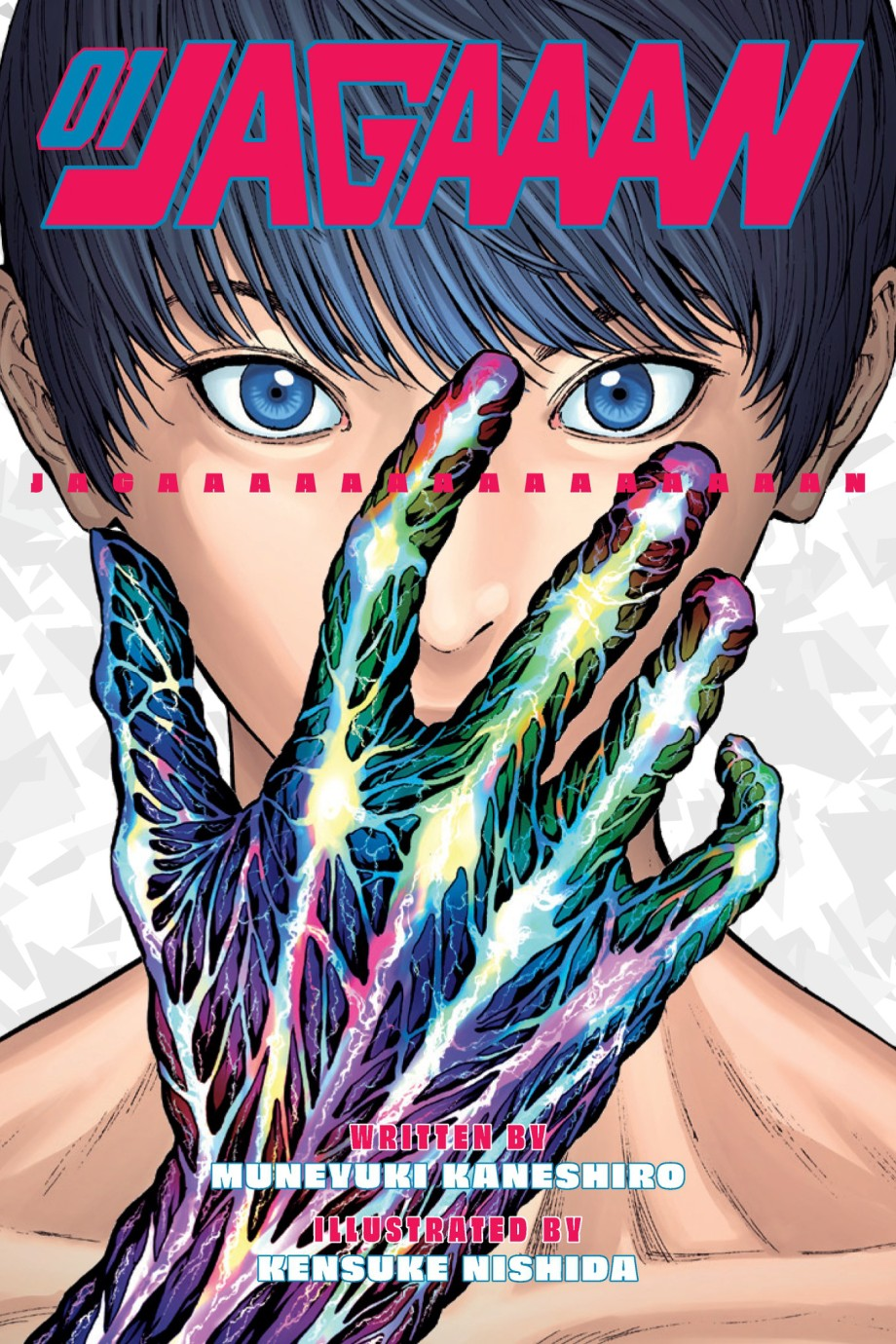
Jagaaan Vol. 1 introduces Shintarou Jagasaki as a police officer already deeply dissatisfied with the life he has built. And beneath the routine, he regularly imagines how satisfying it would be to eliminate the people who irritate him. Muneyuki Kaneshiro and Kensuke Nishida push that resentment into increasingly grotesque territory, building a supernatural horror story around what happens when desires that should remain buried begin taking physical form.
Plot
Shintaro Jagasaki appears to have a stable future waiting for him. He works as a neighborhood police officer, lives with his longtime girlfriend Yuriko, and seems headed toward marriage and children. Internally, however, he finds that future suffocatingly dull, masking his frustration behind agreeable smiles while fantasizing about firing off at the people around him. Everything changes when a man aboard a train mutates into a grotesque Fractured Human and Jagasaki discovers that his own right hand can transform into a fleshy firearm.
The seven chapters escalate quickly from there. Frenzied Frogs infect humans and allow buried impulses to erupt through monstrous transformations, while Jagasaki learns that he has been infected without completely losing himself. His encounters become increasingly personal when Yuriko transforms and he is forced to (spoiler alert) kill her, followed by another violent outbreak at a wedding. The volume throws information, body horror, dark comedy, and action together at an almost reckless pace, yet the momentum suits a protagonist whose previously predictable life has suddenly become anything but.
Characters
Jagasaki is an intentionally uncomfortable protagonist. He is frustrated, dangerous, passive-aggressive, deeply dissatisfied, and capable of imagining horrific violence long before supernatural powers give those fantasies physical consequences. What makes him interesting is the distance between the harmless persona he performs and the resentment underneath it. His new ability offers freedom from the routine he despises, creating an unsettling excitement even when everything surrounding that freedom is catastrophic.
Yuriko’s expectations for marriage help establish the ordinary future Jagasaki resents, though her role in this opening volume is deliberately tragic. Doku, the talking owl who begins accompanying Jagasaki, provides a much stranger counterpoint, explaining pieces of the infection while consuming the Frenzied Frogs that emerge from defeated Fractured Humans. Together, these relationships establish a world where absurd comedy can sit beside death and grief without completely relieving the tension.
Art
Kensuke Nishida gives Jagaaan a visual identity built around collision. Human characters retain relatively grounded proportions until their desires physically (and drastically) distort them, at which point jaws, limbs, tongues, and entire bodies can expand into grotesque new shapes. The transformation imagery is unapologetically graphic, with gore and anatomical distortion used to make each Fractured Human feel like a corrupted extension of the person underneath.
Jagasaki’s own mutation is one of the volume’s strongest designs. His hand becoming a biological gun gives the action a visceral quality that conventional weapons could not achieve, while increasingly destructive shots allow the battles to become larger without abandoning the body horror at their center. Nishida also gives expressions plenty of room to become exaggerated and ugly, particularly when buried frustration finally breaks through a character’s socially acceptable exterior.
Themes
Desire is the mechanism driving almost everything. The Frenzied Frogs do more than create random monsters; their hosts become physical expressions of impulses that have been suppressed, distorted, or allowed to consume them. Jagasaki fits naturally into that system because he has already spent his life performing satisfaction while privately wanting to destroy the future unfolding in front of him.
That makes the volume particularly interested in the gap between social expectation and private thought. Work, marriage, adulthood, and happiness are presented as recognizable milestones, but Jagasaki’s general resentment exposes how hollow following them can become when desire and obligation no longer align. Just know—it’s unafraid to go dark while embarking on that wild thematic journey.
Verdict
Jagaaan Vol. 1 is an aggressive, grotesque introduction fueled by striking body horror, kinetic action, and a protagonist whose darkest impulses are inseparable from his new power. Its willingness to make desire simultaneously liberating, destructive, and deeply uncomfortable gives this darker story an identity worth following.