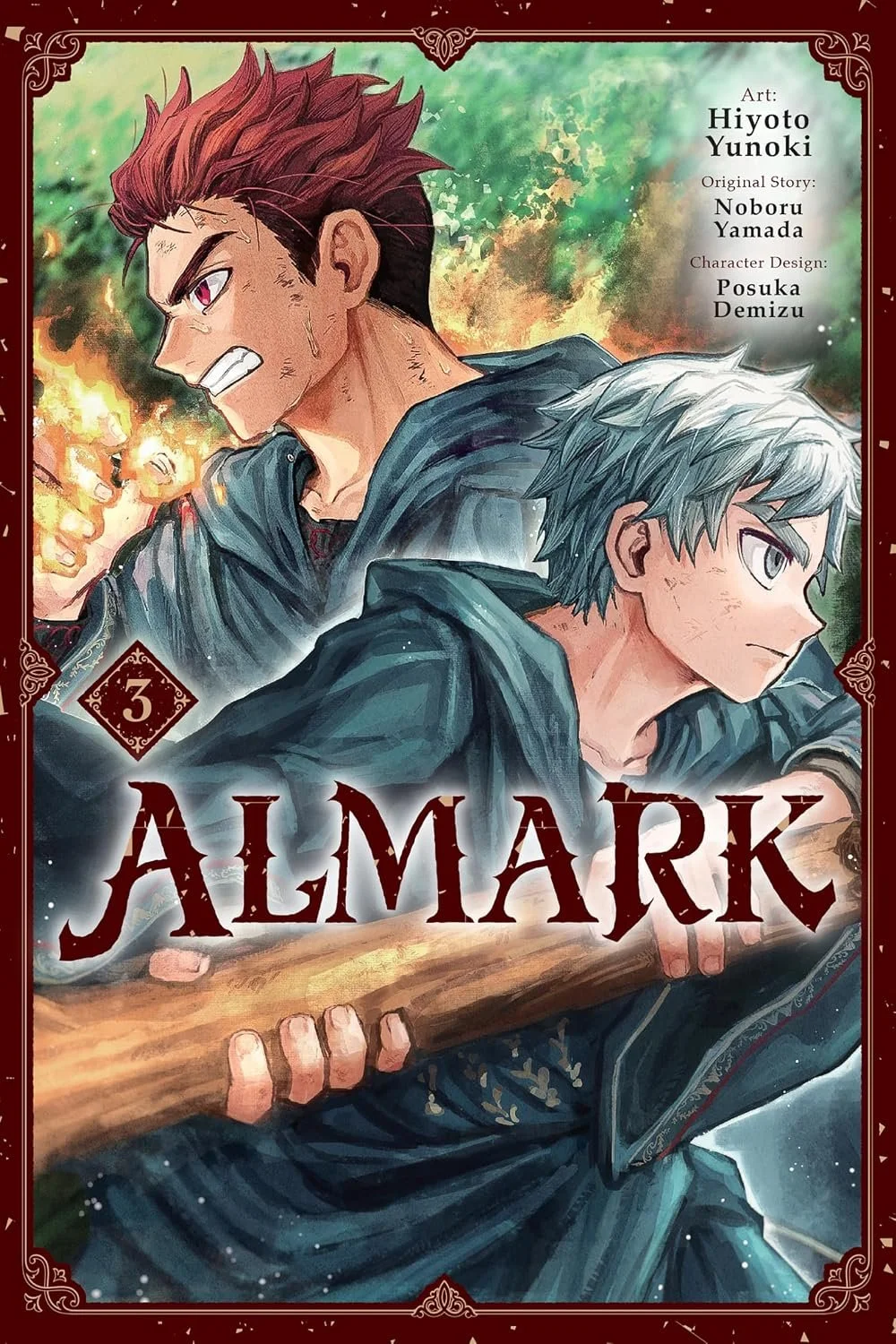

Almark: Vol 3 Review
By its third volume, Almark has developed into a rewarding blend of magical-school fantasy, adventure, and character-driven warmth. Chapters 10 through 14 place Almark in situations ranging from a dangerous rescue to his first major examination, revealing how much he has learned even as conventional magic remains beyond his reach.
Plot
The volume begins with first-year student Eldo being abducted by a Jaranon, sending Almark into the forest with Tohrk close behind. Almark’s knowledge of monsters and tracking allows him to identify the creature’s habits, while Tohrk uses magic to illuminate the scent it left across trees, stones, and the surrounding terrain. Their complementary abilities give the pursuit a strong sense of momentum and turn a former rivalry into an unexpectedly satisfying partnership.
From there, the story shifts comfortably between mystery, school life, and academic pressure. A supposedly haunted garden leads Almark, Wendy, and Nelson through a hedge maze, though its wandering voice ultimately comes from Norish’s unfinished wind-message spell rather than a ghost. Summer plans then give Almark and Morgan something to anticipate before a rigorous three-day examination tests written knowledge, practical skills, oral responses, and magic. The variety keeps the volume lively while leaving larger concerns surrounding the forest and the difficult-to-read Wollis unresolved.
Characters
Tohrk receives some of the volume’s strongest development. His pride still makes him abrasive, yet it also compels him to follow Almark rather than leave a younger student in danger. He struggles to match Almark’s physical endurance but contributes the magical precision needed to continue the pursuit, demonstrating courage, intelligence, and a growing ability to respect someone whose background differs sharply from his own.
The quieter chapters give the ensemble similar attention. Norish’s messages to a statue resembling her late grandfather reveal a history of grief and bullying, while Nelson’s clumsy attempt to reassure her exposes the loyalty beneath his louder personality. Morgan’s disappointment over remaining at school and Wendy’s invitation to visit her family also allow Almark to behave more like an ordinary boy, particularly as his desire to see Wendy begins competing with his relentless focus on training.
Art
Hiyoto Yunoki brings considerable energy to the forest sequence. Thick vegetation, uneven ground, narrow paths, and layered tree trunks make the pursuit feel physically demanding, while shifting panel sizes convey the speed with which Almark moves through the environment. Tohrk’s sweat, strained posture, and increasingly severe expressions create a clear visual contrast with Almark’s practiced control.
The character work remains equally effective during less dangerous scenes. Yunoki moves easily between restrained emotion and exaggerated comedy, giving the younger students expressive faces without losing the grounded quality of the fantasy world. Small reactions often carry the interpersonal development, allowing embarrassment, admiration, anxiety, and affection to register before the dialogue fully articulates them.
Themes
Volume 3 repeatedly considers how different forms of ability can work together. Almark’s survival instincts cannot replace Tohrk’s magic, just as Tohrk’s spellcraft cannot reproduce Almark’s stamina or knowledge of monsters. The rescue succeeds because both boys accept distinct roles, giving the action a broader purpose beyond defeating a creature.
The examination extends that idea inward. Almark initially measures himself against classmates who can perform visible spells, leaving months of meditation feeling insignificant. He eventually recognizes that meditation is the genuine result of his training and chooses to demonstrate what he has actually learned rather than force a more impressive technique. His progress comes from understanding the value of an achievement that others noticed before he did.
Verdict
Almark Vol. 3 is a well-balanced continuation that strengthens its ensemble while moving confidently between action, mystery, humor, and school-life fantasy. Its most rewarding moments show Almark discovering that growth can take many forms, including those that remain invisible until they are truly needed.