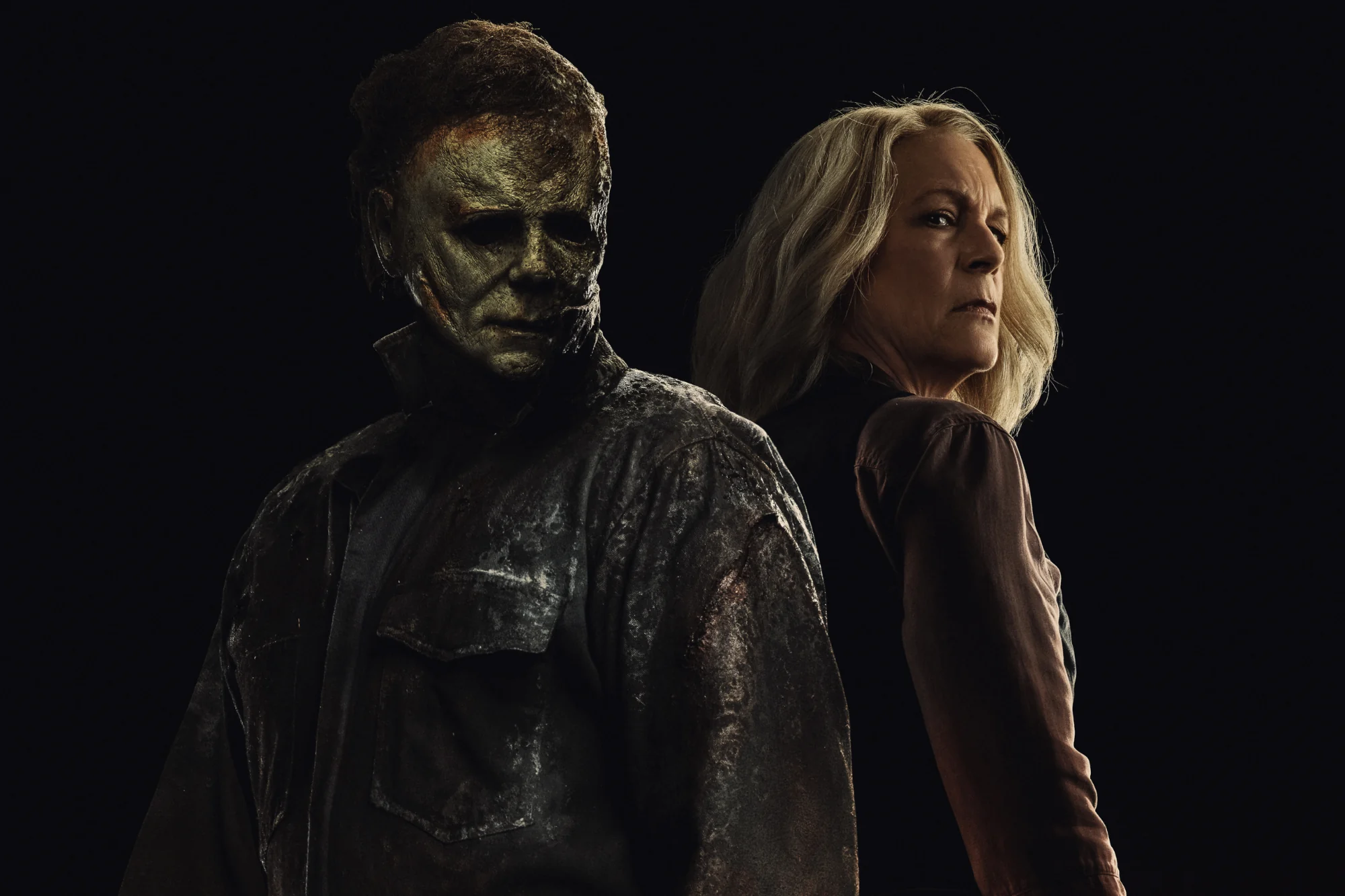

Few horror franchises are as closely associated with October as Halloween. Michael Myers and his unmistakable white mask have become staples of the season, and with 13 films spanning several decades, there’s plenty to discuss when it comes to the franchise’s highs and lows. Some sequels have earned their place among the genre’s best, while others have made questionable creative choices that remain divisive among fans. With Halloween approaching, we’re ranking all 13 films from worst to best, revisiting what works, what doesn’t, and which entries are worth adding to your next horror marathon.
Spoilers ahead for the entire franchise.
13. Halloween: Resurrection (2002)
A reality webcast inside the Myers house, with Tyra Banks involved, sounds like the setup for an entertainingly ridiculous sequel. Resurrection quickly sours that possibility by killing Laurie in its opening stretch, then compounds the frustration with murky visuals that make following the action a chore. Busta Rhymes fighting Michael with martial arts supplies a memorable absurdity, although the movie never finds enough personality to make its silliness consistently enjoyable. Every Halloween entry warrants at least one viewing for the full experience, but this is the easiest to leave off next year’s rotation.
12. Halloween 5: The Revenge of Michael Myers (1989)
Following the high of Halloween 4, this sequel makes a baffling choice by killing Rachel before her relationship with Jamie can develop further. Leaving Jamie unable to speak for much of the film also restricts the dynamic that gave its predecessor such an effective emotional foundation. Harris still makes her distress register, but the surrounding characters rarely offer enough reason to care who survives next. By the time the movie introduces another mystery instead of resolving its existing business, it feels as though the series has discarded its best opportunities.
11. Halloween: The Curse of Michael Myers (1995)
Inheriting Halloween 5’s unresolved mysteries, The Curse of Michael Myers attempts to explain them through a conspiracy that makes Haddonfield’s problems considerably more complicated. Paul Rudd’s adult Tommy Doyle gives the investigation some appeal, especially when his childhood encounter with Michael informs his obsession. Unfortunately, the cult mythology and experimentation pull attention toward explanations that make the central threat less compelling the more we learn. Rudd helps keep it watchable, but even he can only do so much with a sequel this overburdened.
10. Halloween III: Season of the Witch (1982)
The franchise’s sole detour away from Michael’s storyline finds its menace inside Silver Shamrock, a Halloween mask company whose products conceal an appalling purpose. Behind its relentlessly catchy commercial jingle is a plot to kill the children wearing those masks, carried out through a bizarre combination of occult ritual and science fiction. How any of it is supposed to work invites some skepticism, but the premise is disturbing enough to linger long after the credits. As the only realized installment of the proposed anthology direction, Season of the Witch makes a memorable case for what the series could have become.
9. Halloween Ends (2022)
After the carnage of Halloween Kills, Halloween Ends shifts much of its attention to Corey Cunningham, using his descent to explore how Haddonfield might cultivate another killer. Green’s trilogy repeatedly wavers over whether Michael is simply a man or something more, and the finale muddies that distinction further by insisting on his humanity while suggesting he can awaken—or even transfer—evil in someone else. Those conflicting implications leave too much unresolved for a satisfying final chapter, while forced character choices make familiar faces feel inconsistent with who we’ve come to know. Fortunately, Laurie receives a welcome moment of closure, though the route there leaves the film struggling to earn its title.
8. Halloween II (2009)
Zombie’s sequel follows Laurie into a profoundly damaged aftermath, where surviving the first film has left her increasingly difficult to reach. Its spectral imagery, particularly the recurring white horse, gives the movie a feverish quality that produces some genuinely haunting passages. However, Annie’s death strips away one of this continuity’s strongest relationships, while Laurie’s prolonged unraveling becomes harder to invest in as the film progresses. There’s definitely a striking vision here, but by the end, we’d spent enough time in this particular nightmare.
7. Halloween (2007)
Rob Zombie’s Halloween gives Michael a grimier, more confrontational world, spending substantial time inside the childhood that precedes his return to Haddonfield. The approach sometimes pushes its ugliness past the point of usefulness, although there’s no mistaking the filmmaker’s commitment to his interpretation. Danielle Harris, returning to the franchise as Annie Brackett after playing Jamie Lloyd, also supplies one of the remake’s most engaging performances. Even when the excess becomes exhausting, this version makes Michael feel physically overwhelming enough to leave a new generation rattled.
6. Halloween II (1981)
Continuing on the same night as the original, Halloween II turns Laurie’s trip to the hospital into an ordeal where help always feels just beyond reach. Its sparsely occupied corridors provide an effective setting for Michael’s pursuit, with the staff gradually becoming casualties of a nightmare they barely understand yet. The revelation that Laurie is his sister reshapes their connection and supplies one of the franchise’s defining twists, even if later timelines abandon it. More explicit violence slightly changes the texture of Carpenter’s original, but there’s really no denying that it’s an absorbing companion piece.
5. Halloween H20: 20 Years Later (1998)
After the increasingly tangled sequels preceding it, Halloween H20 gives the series a welcome jolt by bringing Laurie back into focus. Her life at a California boarding school offers a fresh setting for her return, where the fear she’s spent years trying to contain now strains her relationship with her son. Curtis gives that struggle enough weight to make Laurie’s eventual decision to confront Michael feel earned, building toward an enormously satisfying payoff. With its autumnal campus atmosphere and brisk pacing, this is an easy pick for an annual October rewatch.
4. Halloween Kills (2021)
Halloween Kills takes the brutality of the 2018 film and goes all gas, no brakes, delivering Michael at his most terrifying. His rampage through Haddonfield gains a frightening momentum as even a town mobilized against him proves devastatingly unprepared. That escalation divided viewers who preferred the franchise’s slower suspense, but its sheer viciousness makes this, for our money, one of the past decade’s most savage mainstream slashers. We totally appreciate a follow-up with the guts to push its killer this far and create a blood-soaked legacy of its own.
3. Halloween 4: The Return of Michael Myers (1988)
The first Michael Myers installment without Laurie Strode takes a considerable gamble, then finds exactly the right people to carry it. Ellie Cornell’s Rachel earns her place among the franchise’s best final girls through a protective streak that makes every escape feel personal. Alongside her, Danielle Harris gives Jamie Lloyd a raw vulnerability and emotional conviction that rank among the genre’s strongest child performances. Their bond certainly makes the movie work on its own terms, right up to a shocking ending that leaves a particularly nasty impression.
2. Halloween (2018)
Reviving Halloween came with enormous expectations, and David Gordon Green met them with a spectacular sequel that understood how much further this story could go. Revisiting Laurie four decades after the original, the film gives her survival lasting consequences, tracing how the fear governing her life has shaped her daughter and granddaughter. Their fractured relationships make the eventual confrontation with Michael feel urgent and deeply personal, building toward one of the franchise’s strongest finales. Bringing those three generations together against an older, meaner Michael is an inspired move, especially when he’s become more frightening with age.
1. Halloween (1978)
John Carpenter’s Halloween helped establish the blueprint for the modern slasher, and its influence still hasn’t diminished the experience of watching it. Dean Cundey’s cinematography makes an ordinary suburban street feel dangerously exposed, while Carpenter’s impeccable score turns Michael’s smallest movements into cause for alarm. Jamie Lee Curtis gives that dread a compelling human center as Laurie Strode, whose resourcefulness makes the final stretch impossible to shake. A 13-film franchise began here, and its first chapter remains the standard every successor has chased.