Undertone Review: A Tense Haunted House Film Driven by Sound and Dread
Ian Tuason’s Undertone opens with a smart, unsettling hook and knows how to sustain that premise for a good while. Conceptually, the A24 horror film follows Evy, a paranormal podcast host who begins listening to a set of mysterious recordings while caring for her dying mother inside the family home, with Nina Kiri anchoring a story largely confined to one claustrophobic location and one increasingly frayed point of view.
What ultimately works in the film’s favor is the way it understands the grammar of haunted-house horror through a newer lens. Undertone plays with podcasting, audio evidence, domestic dread, religious imagery, and family anxiety in ways that feel familiar to the genre while still carrying a generational edge. It may not chart entirely original territory, but it still feels like a solid and often effective take on haunted-house horror for audiences who came of age after the Paranormal Activity boom and have had relatively few standout variations on that formula since.
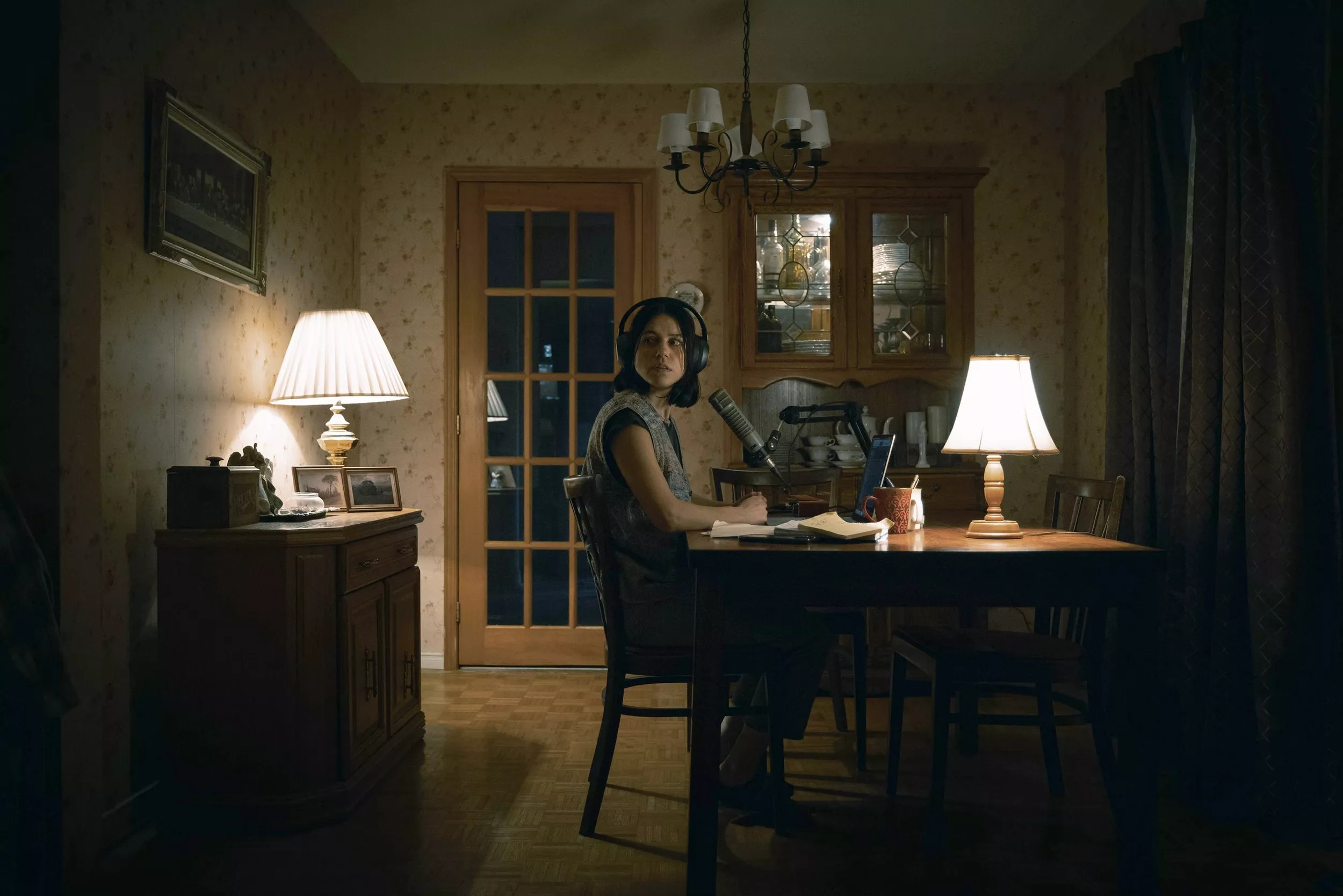
Undertone | Photo Credit: A24
Sound is the movie’s sharpest weapon
The most impressive thing about Undertone is easily its sound design. This is a horror film that knows auditory terror can do more than just deliver jump scares, and for much of its runtime, it uses sound with real precision. Sometimes that means a sudden blast, a warped voice, or a noise that arrives too loudly and too close. At other points, it is subtler than that, using silence, repetition, distortion, and small ambient details to create the feeling that something in the room is not right even before the film confirms it.
That nuance is what elevates the movie. The scares are not limited to one mode, and that generally keeps the tension alive. Some land on a big theatrical level, especially when the film wants to overwhelm the senses, but many of the best moments are smaller and more controlled. The unease comes from listening carefully, from trying to parse what was said, what was heard, and whether any of it can be trusted. For a movie built around recordings and interpretation, that is exactly the right instinct. For viewers who are not especially interested in the genre’s nuances, that level of detail may end up feeling more distancing than immersive, especially compared to a simpler popcorn horror ride.
A haunted house that actually feels claustrophobic
Visually, Undertone is just as assured. Tuason and his team understand how to shoot a house so it starts to feel like a trap. The framing is strong throughout, and the camera repeatedly finds ways to make ordinary domestic space feel unstable. Hallways tighten. Doorways become thresholds your eyes gravitate towards. Mirrors, darkness, and flashing lights all show up as expected tools of the genre, but the film uses them with enough control that they do not feel entirely secondhand.
In a movie like this, movement (or placement) matters. The camera has to create the sensation that something could be behind Evy, near Evy, or moving toward her even when the frame appears empty. Undertone gets a lot of mileage out of that uncertainty. It understands how haunted-house horror thrives on anticipation, and its visual language keeps feeding that dread. The result is a film that feels genuinely boxed in, which is exactly what this material needs.
A familiar genre setup with a fresher generational pulse
Part of what makes Undertone easy to get into is that it understands the pleasures of haunted-house horror without pretending it is above them. There is lore. There is family dread. There are fragments of the past bleeding into the present. There is a woman alone in a house trying to make sense of signs she may already be too deep inside to escape. None of that is radically new, but the podcast angle gives the film a contemporary frame that helps it stand apart just enough.
That is where the movie finds its identity. It feels like a haunted-house story filtered through media obsession, digital curiosity, and the urge to keep decoding something even when it is clearly becoming dangerous. Listening essentially becomes its own form of trespassing. That gives the film a modern texture, even when its deeper mythology is more standard.
The final act says a Little too much
For most of its runtime, Undertone benefits from holding back. It is strongest when it lets viewers sit in uncertainty and dread rather than overcommitting to explanation. That is why the final act ends up being the film’s biggest weakness. The story remains mostly strong overall, but it eventually starts spelling out too much, and the issue feels less rooted in the information itself than in how heavily it is delivered.
The mythology itself is fine, if somewhat familiar, but the way the film handles it becomes a little too overt. The backwards audio, the deciphering, the emphasis placed on the tenth clip as a kind of major catalyst, and some of the more gimmicky explanatory beats all push the movie away from its most effective mode. That said, Undertone ultimately proves itself as a worthwhile watch because so much of the craft around it is strong.
Score: 7.5/10
Undertone thrives on superb sound design, oppressive camerawork, and a contemporary mix of podcast horror, family dread, and supernatural lore. Even when it overexplains its mythology, it still lands as a stylish, well-crafted haunted-house thriller with real atmosphere.