
Heize Catches the Love Virus
Across a decade of hits, from early breakout singles to chart-topping collaborations and drama OSTs, Heize has built a world where late-night thoughts, unresolved conversations, and half-healed scars sit at the center of the story.
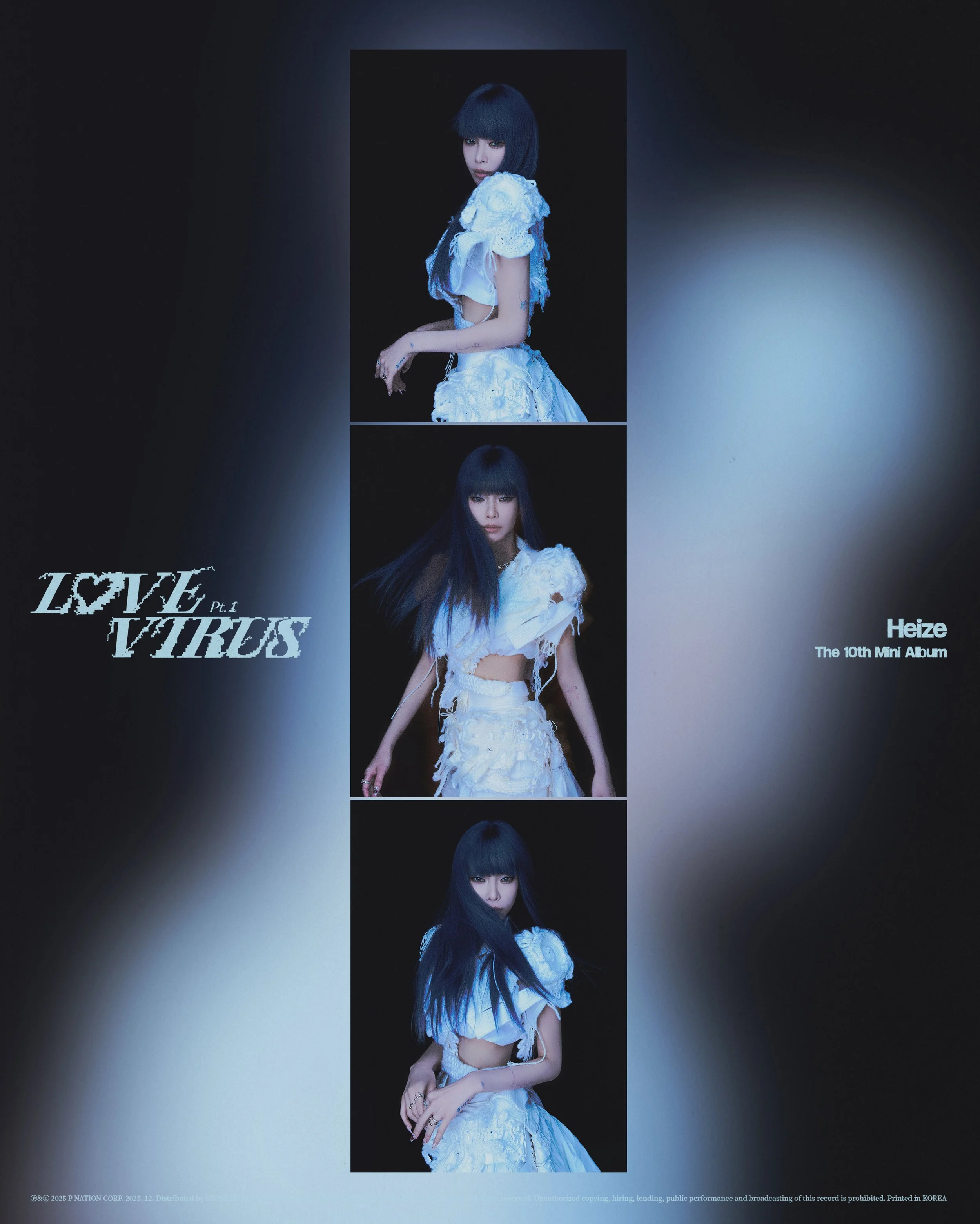
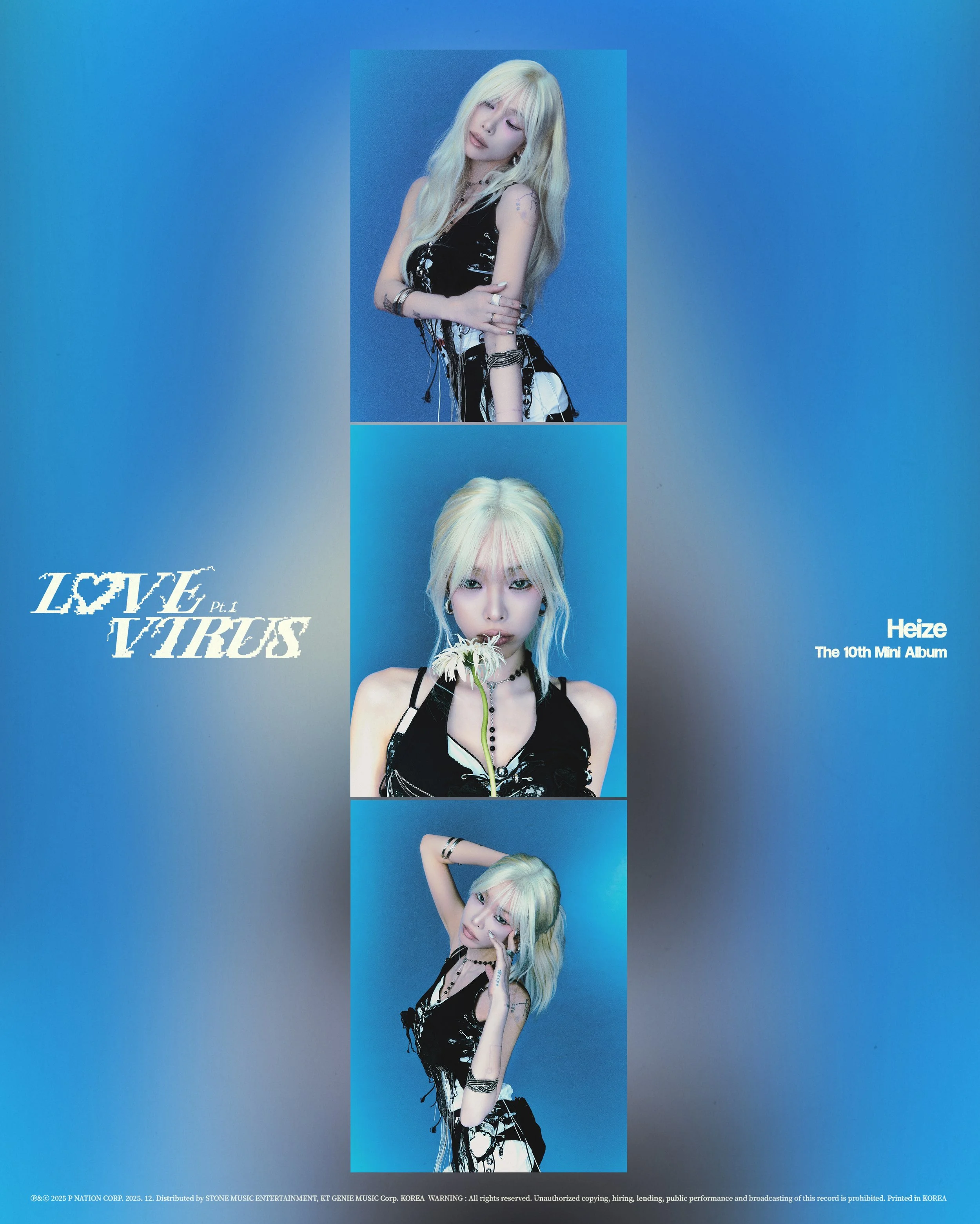
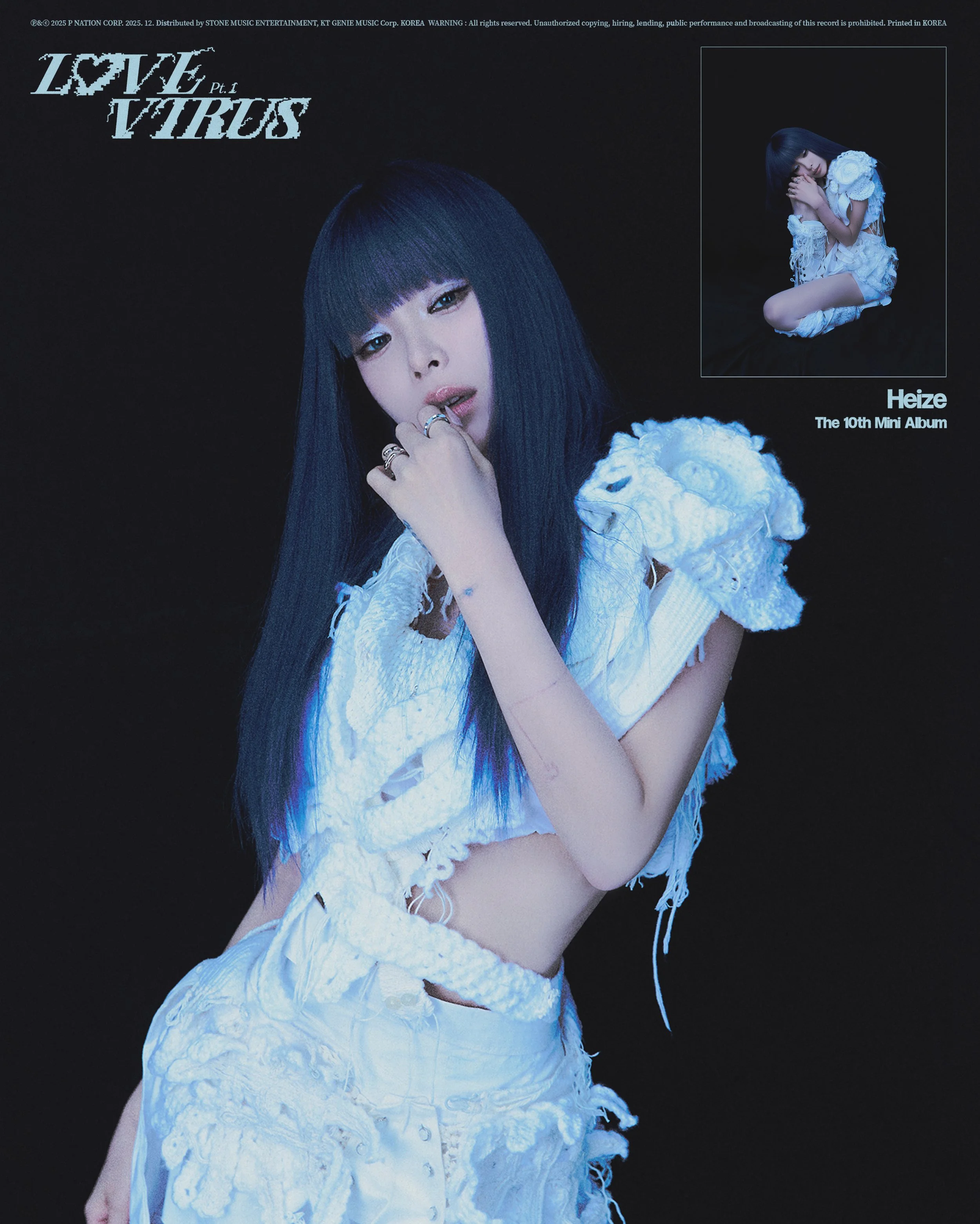
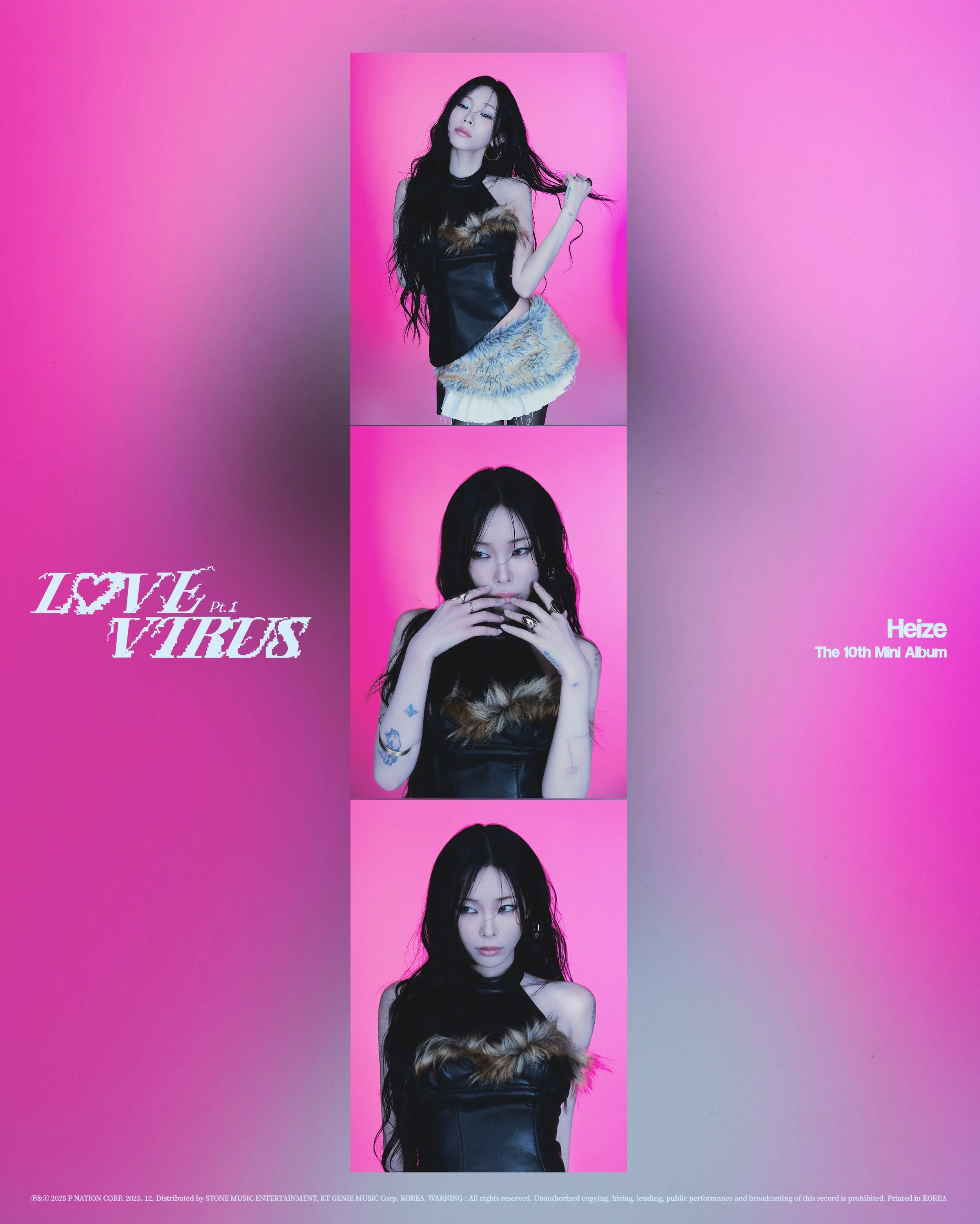
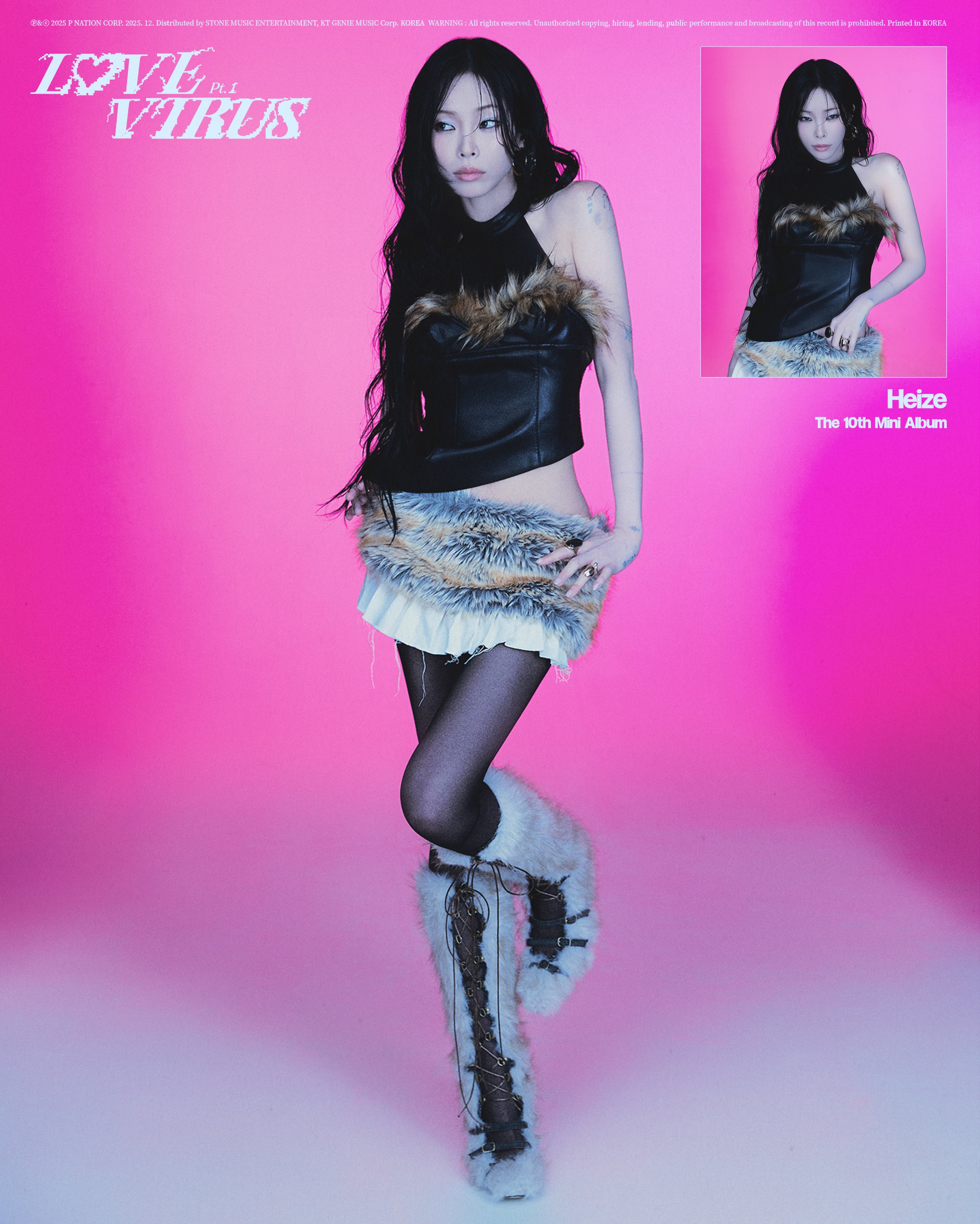
Her 10th mini album, [LOVE VIRUS Pt.1], sinks even further into that space and twists it into something a little more unsettling. Here, love isn’t just tender or bittersweet. It behaves like a glitch that quietly spreads through your whole system, leaving behind traces, errors, and cracks you can’t fully erase.
Her infectious R&B-and soul-leaning EP gathers six tracks that live on that same fault line. The title song, “Love Virus” featuring I.M, imagines affection as something infectious and unstable, impossible to contain, no matter how careful you are. From there, “Last Taxi” featuring BTOB’s Lee Changsub, “All Because of You,” “The Last Hello,” and “You Made Me” all trace what happens after the first rush fades. Each song feels like a different stage of infection: denial, obsession, hope, and the strange calm that follows when you finally accept an ending.
Visually and emotionally, [LOVE VIRUS Pt.1] also plays out in a neon city at midnight, full of static and digital errors that keep interrupting the frame. Two people collide, fall hard, and slowly grow sharp with each other until what once felt electric starts to sting. By the time they drift apart, they almost sound immune to the very feelings that lit everything up in the first place. In the end, the project is Heize tracing every mark love leaves behind and letting even the smallest of them speak.
Now, she’s unpacking that world for Stardust in our interview with one of Korea’s most dynamic storytellers.

Congratulations on the release of [LOVE VIRUS Pt.1], which also happens to be your 10th mini album. When did the idea of love as a “virus” and an “error” first click for you as the core of this project?
Heize: Hello, this is Heize, back with my 10th mini album. It still feels surreal to say ‘tenth.’ I’m grateful that I can come back with new music during my favorite season. The reason I chose to interpret ‘love’ as a ‘virus’ or ‘error’ is quite simple. A single mistake can become something that wastes your time, drains your emotions, or even causes pain… everything suddenly becomes inefficient. But after we go through that fever caused by the ‘virus,’ we come out with a kind of immunity that helps us love better the next time around. To me, love isn’t an error that needs to be deleted, but a virus we have to endure and heal from in order to love more deeply in the future.
The title track “Love Virus” brings I.M into your universe. What drew you to his voice and perspective for this song, and how did your collaboration shape the final version?
Heize: I’ve always felt that I.M’s voice carries a warm kind of instability. On the outside, it might sound calm and composed, but inside, it feels full of layered emotions. In this song, which holds the tension between wanting to erase memories but being unable to erase the feelings, I felt his voice played the role of “cold reason.” With my vocal, which is filled with emotion and turmoil, his calm, cool tones cut through like a quiet command whispering, ‘There’s no choice but to erase these memories.’ That contrast allowed the song to take on a more three-dimensional form. I’m truly grateful for what he brought to it.
The concept hints at an incubation period, two people falling for each other, then a relationship turning sharp and infected with tension. When you brought that story into the music video, what did you want the visuals to reveal that the songs alone could not?
Heize: If the song captures the ‘inner’ parts of emotion, then the music video reveals the ‘external traces’ those emotions leave behind. When love breaks apart, it’s not just the relationship that shatters; it’s the spaces we shared, the time, the objects, and all the fragments of our memories. I wanted to show that visually. When we try to erase painful memories, there’s always the fear that the version of ourselves who grew through that love might disappear too. I tried to express that fear through the chaotic cityscape and distorted visuals.
[LOVE VIRUS Pt.1] lives in an R&B and soul lane, but your catalog moves between hip hop, pop, ballads, and more. What does this chapter say about where you are right now as an artist?
Heize: This album was a journey back to the source of ‘Heize’s emotional world.’ All the different genres I’ve shown so far were just tools to express emotions delicately, but the core has always been honest storytelling, paired with melodies I naturally gravitate towards. This time, I wanted to pull out the warmest, most healing emotions during this cold season. To me, [LOVE VIRUS Pt.1] is an album that shows that Heize ultimately ‘breathes through emotion.’
“Last Taxi” with LEECHANGSUNG already sounds like a story in itself. What was the starting point for that collaboration, and how did you imagine the two voices interacting inside the same song?
Heize: When I heard LEECHANGSUB’s singing, I once felt a sort of gentle kindness with a hint of bitterness beneath it. That was exactly the tone I was looking for. “Last Taxi” tells the story of the very last moment when two people turn away from each other after a breakup. The woman tries to escape the man, while the man tries to return to the woman… both in a taxi at the same time. This duet, where two people in the same space with completely different emotions, was only possible because of LEECHANGSUB’s voice.
Because someone who doesn’t match the words ‘regret’ or ‘attachment’ was the one singing about ‘regret’ and ‘attachment’, the song gained its final emotional completeness. Listening to his voice made me think of soju, even though I don’t drink much. [laughs]. I’m very grateful to him.
The album concept talks about glitches, cracks, and the traces love leaves behind in a city at dawn. What kind of imagery or settings were living in your head while you were writing these songs?
Heize: The images I pictured the most were cold dawns and a humid city. And a cracked window glass. When love comes to an end, the world continues unchanged, but to us, everything looks fractured, like a broken filter over the entire city. The smudged city lights, the dim streetlamp, the cold river… even when we want to erase everything, it lingers like an afterimage of love. I wanted to share that coldness with the people who have felt it, and in that shared space, find an unexpected warmth.
This is obviously Part 1 of [LOVE VIRUS]. Without giving too much away, how do you see this chapter connecting to what comes next? Are there questions you are purposely leaving unresolved here?
Heize: The biggest question Pt. 1 raises is, ‘Do these painful memories really need to be erased?’ Throughout the album, the conclusion becomes clear: we want to erase them, but we can’t. That realization creates enormous confusion. Pt. 2 will likely capture the process of overcoming and accepting that confusion. If this part is about denial of the breakup, the next part is about acceptance and preparing yourself for the next love. I hope the next chapter spreads the belief that the end of one love is the beginning of another.
You have been known for deeply emotional storytelling since your debut. With [LOVE VIRUS Pt.1], what did you learn about yourself as a writer or producer that you had not seen clearly before?
Heize: In the past, I focused on recording emotions in the purest form, ‘sadness as sadness.’ But this time, I wrote while asking, ‘Why did this sadness form?’ and ‘What meaning does it leave behind?’ Through the pain of love, this album helped me discover the language of hope. I’m grateful for that, and hope that message reaches many people. [Also] thank you for taking the time to read this long interview—I hope everyone can spend the end of the year wrapped in warmth, along with my new album. Bye!
Heize’s 10th mini album [LOVE VIRUS Pt.1] is out now.